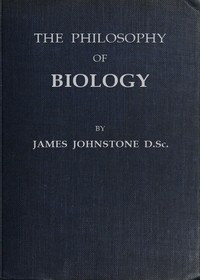
The philosophy of biology — Reading Notes

(0 User reviews)   1468
In Category - Ecology
Johnstone, James, 1870-1932 Project Gutenberg 2020 Not confirmed
Biology Readers of public-domain and historical texts
Project Gutenberg digital edition en

Edition facts

Words 119,911
Reading time 522 min
Text sections 22

The philosophy of biology — Reading Notes can be approached with a clearer sense of reading commitment from its source measurements: 119,911 words, 8 hr 42 min estimated reading time, and 22 detected text sections.

The text analysis averages about 26.1 words per sentence, while the detected sections provide another way to judge how the source is divided.

Project Gutenberg metadata also associates the work with “Biology,” connecting these edition facts with the source record’s subject description.

James Johnstone's 1914 work examines biology through a philosophical lens, questioning whether scientific descriptions capture reality. The author uses the metaphor of shadows to critique mechanistic models and Mendelian genetics, urging readers to consider the limits of empirical knowledge.
Share
Editorial Edition Score 4.9/5

Calculated from edition completeness, EPUB availability, text structure and catalogue metadata. Not a user rating.

How this score is calculated
  • Description quality20 pts
  • Title & short description10 pts
  • Source metadata20 pts
  • Text length15 pts
  • Chapters / structure15 pts
  • EPUB file integrity20 pts

Total of 100 points, scaled to a 2.5-5.0 range. Editions with an empty description or a missing EPUB file are not scored.

Edition quality

Public-domain source text

Read the source text

The source text is kept in the dedicated reader, separate from this catalogue record and its commentary.

James Johnstone opens The Philosophy of Biology with a striking metaphor: science describes the shadows of things, while philosophy seeks the reality that casts them. Drawing on Driesch, he distinguishes description from understanding, setting a reflective tone that pervades the book. The excerpts reveal a writer who is as concerned with the limits of scientific language as with biological facts.

Shadows and Givenness

Johnstone’s introductory paragraphs establish a philosophical framework that is both humble and ambitious. He describes scientific knowledge as “our perceptions, thinned out” and modified by mental organisation—a phrase that captures his view of empirical data as filtered, not raw. The shadow metaphor recurs implicitly when he later critiques the Mendelian concept of “unit-characters,” arguing that such terminology “symbolises, rather than describes” experimental results. This caution against reifying theoretical constructs is a thread running through the excerpts. Johnstone does not dismiss Mendelian genetics; instead, he insists that factors like “tallness” or “dwarfness” are convenient fictions, not physical entities. His voice is measured, but the underlying argument is sharp: science must remember that its models are approximations, not truths.

The Machinery of Heredity

In a dense passage on germ-cell division, Johnstone invites the reader to “puzzle out for himself” the meaning of chromosomal behaviour. He then constructs a hypothetical mechanism of “unimaginable complexity” in which chromatin bodies are assembled like parts of a dynamo. This analogy is deliberately mechanical, echoing the physics of an earlier generation that sought reality in atoms and motions. Yet Johnstone undercuts the analogy by calling it “strange” that such a logically constructed mechanism would correspond to reality. The prose here shifts from exposition to a kind of Socratic questioning, forcing the reader to confront the gap between hypothesis and evidence. The pace slows as he dwells on the assumptions underlying Weismannian and Mendelian models, making clear that he regards them as useful but provisional.

A Voice of Caution

Throughout the excerpts, Johnstone’s narrative voice is that of a guide who is both learned and sceptical. He uses direct address—“let the reader puzzle out”—to engage his audience, and his sentences often build a careful argument before delivering a quiet rebuttal. For instance, after describing the Mendelian factor hypothesis, he notes that “all the objections that may be urged against the Weismannian hypothesis … apply also to the Mendelian hypotheses.” This pattern of presenting a model and then exposing its limitations gives the text a dialectical rhythm. The language is formal but not obscure; Johnstone prefers concrete examples (sodium chloride, brown and blue eyes) to anchor abstract points. His tone is never dismissive, but he consistently reminds readers that scientific terms are tools, not discoveries.

Readers approaching The Philosophy of Biology should expect a work that moves between detailed biological exposition and philosophical reflection. Johnstone does not offer final answers; instead, he models a critical stance toward scientific orthodoxy. Pay attention to his use of analogy and his habit of qualifying claims—these are the fingerprints of a writer who believes that understanding begins with doubt.

Johnstone’s shadows kept returning to me this afternoon—how every mechanism we trace is only a shape cast by something livelier. I recalled tramping through tidelands with that old ecology manual, watching crabs scuttle past my own uncertain measurements. Both books seem to whisper the same quiet doubt: what we map is never quite the shore itself. Guide to the study of animal ecology — Context and Discussion felt like a hand reaching back, gently, to that very unease.

There are no reviews for this eBook.

0
0 out of 5 (0 User reviews )

Add a Review

Your Rating *
There are no comments for this eBook.

Reader reflection

Your personal reading reflection

Build a private reading journal entry for this title.

Your progress 0 / 10
1

What is your current status with this title?

2

What was your overall reaction to the book?

3

Is this a title you would suggest to others?

4

Did the language feel accessible?

Related eBooks