An Attempt to Investigate the Seat of Animal Life — Edition Insights
Edition facts
The source record for An Attempt to Investigate the Seat of Animal Life — Edition Insights measures this digital text at 9,295 words, 41 min estimated reading time, and 6 detected text sections.
The text analysis averages about 31.1 words per sentence, while the detected sections provide another way to judge how the source is divided.
Project Gutenberg metadata also associates the work with “Life (Biology),” connecting these edition facts with the source record’s subject description.
Calculated from edition completeness, EPUB availability, text structure and catalogue metadata. Not a user rating.
How this score is calculated
- Description quality20 pts
- Title & short description10 pts
- Source metadata20 pts
- Text length15 pts
- Chapters / structure15 pts
- EPUB file integrity20 pts
Total of 100 points, scaled to a 2.5-5.0 range. Editions with an empty description or a missing EPUB file are not scored.
Public-domain source text
Read the source text
The source text is kept in the dedicated reader, separate from this catalogue record and its commentary.
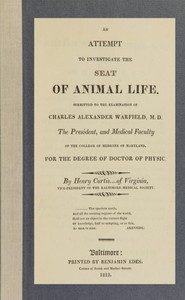
Henry Curtis's 1812 inaugural essay, submitted for the degree of Doctor of Physic at the College of Medicine of Maryland, opens with a striking modesty. He states he is 'induced rather to offer some general opinions on the state of the animal system, than to enter into particular disquisitions on given points,' and he explicitly disclaims any hope of advancing medical science, aiming only not to 'embarrass its progress by hasty conclusions or fanciful chimeras.' This cautious, deferential posture shapes the entire work, which proceeds through a careful review of prior theories before advancing its own argument for the brain as the seat of animal life.
A Rhetoric of Humility and Precision
Curtis's prose is marked by a deliberate modesty that frames his argument as tentative and provisional. He writes under 'peculiar circumstances' that preclude thoroughness, and he presents his opinions 'with as much perspicuity and order as my application to other engagements would permit.' This is not mere convention; it shapes his method. He characterizes earlier theories as 'scintillations of imagination' rather than 'effulgent light of reason,' a metaphor that reveals his commitment to empirical caution. His own explanation he calls 'the more unexceptionable,' a phrase that prioritizes avoiding error over claiming novelty. The reader is thus guided through a text that constantly acknowledges its own limits, even as it builds a case for a specific physiological center.
Life as a Quality, Not a Substance
Curtis carefully distinguishes life from its manifestations. He defines life as 'the quality that distinguishes dead from living matter,' a quality that 'may consist in an aptitude to action' and can persist even after its active effects cease. This is not a metaphysical abstraction; he grounds it in observable phenomena, such as hibernating animals that appear dead yet retain the capacity for action. He argues that this 'aptitude' admits of increase or diminution, and when it is entirely destroyed, the difference between dead and living matter becomes apparent. By treating life as a quality impressed on the nervous system—'possibly something in the way that bodies are endowed with the power of affinity or principle of gravity'—Curtis avoids both vitalism and pure materialism, positioning his argument within a framework of natural philosophy.
The Brain as the Point of Concentration
The central claim of the dissertation is that the brain is 'the point where all the powers of the animal appear more completely concentrated,' with its continuations—the nervous elongations—serving as 'the active agents of life.' Curtis supports this with direct and collateral arguments, emphasizing the brain's role in intellectual operations and its importance in the economy of the system. He acknowledges that the mode of connection between mind and matter is not demonstrable to the senses and will likely remain among 'the arcana of nature,' but he insists that we continually witness their effects. This pragmatic approach allows him to propose a physiological seat for life without overreaching into metaphysics, a balance he maintains throughout the text.
The Structure of an Inaugural Essay
The work's structure reflects its origin as a dissertation. It begins with a title page, a dedication to William Foushee and John H. Foushee, and a second inscription to professors Davidge and Cocke. The 'Preliminary Observations' establish the author's modest aims and method. The body then reviews prominent opinions on life, dismissing them as imaginative, before presenting his own theory. The text is concise—under 10,000 words—and its arguments are presented in a series of paragraphs that move from general observations to specific claims. The closing sections, though incomplete in the excerpts, suggest a return to the theme of the brain's centrality. This formal structure, with its dedications and cautious framing, situates the work firmly within the conventions of early 19th-century medical education.
Curtis's essay offers a window into the intellectual world of an early American medical student. His careful diction—'aptitude,' 'scintillations,' 'unexceptionable'—reveals a writer acutely aware of his place in a tradition of inquiry. Readers interested in the history of neuroscience or the rhetoric of scientific modesty will find here a compact, revealing text. The dissertation does not resolve the question of life's seat, but it models a disciplined approach to a question that remains, in many ways, open.
Reading Curtis’s careful deference to old authorities, I remembered my grandfather’s anatomy atlas, its margins penciled with his own hesitant questions. There, life felt like a secret held in tissue. That same quiet wonder returned years later, in the pages of The philosophy of biology — Reading Notes, where definition itself became a kind of breathing, not a conclusion but a pause.
There are no reviews for this eBook.
What did you think of this book?
Answer a few questions and save a private reflection on this device.