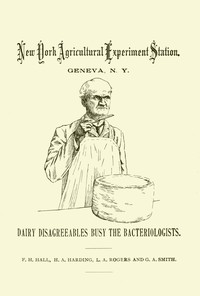
Dairy Disagreeables Busy the Bacteriologists — Inside the Classic
Edition facts
The source record for Dairy Disagreeables Busy the Bacteriologists — Inside the Classic measures this digital text at 6,147 words, 27 min estimated reading time, and 5 detected text sections.
The text analysis averages about 20.8 words per sentence, while the detected sections provide another way to judge how the source is divided.
Project Gutenberg metadata also associates the work with “Dairy microbiology,” connecting these edition facts with the source record’s subject description.
Calculated from edition completeness, EPUB availability, text structure and catalogue metadata. Not a user rating.
How this score is calculated
- Description quality20 pts
- Title & short description10 pts
- Source metadata20 pts
- Text length15 pts
- Chapters / structure15 pts
- EPUB file integrity20 pts
Total of 100 points, scaled to a 2.5-5.0 range. Editions with an empty description or a missing EPUB file are not scored.
Public-domain source text
Read the source text
The source text is kept in the dedicated reader, separate from this catalogue record and its commentary.
The bulletin opens with a blunt commercial truth: “Good flavor sells milk, cream, butter and cheese; poor flavor condemns them.” This sentence, from F. H. Hall’s section on flavor, immediately establishes that the authors address practical dairy problems, not abstract science. The opening pages list the Station’s board and staff—including Governor Theodore Roosevelt—grounding the work in institutional authority. Readers first encounter a problem-driven structure: each “disagreeable” is named, described, and then given causes and cures. The tone is direct, almost conversational, as when the text notes that good flavor “often passes unnoticed because so familiar.”
A Collaborative Voice from the Station
The title page credits four authors—Hall, Harding, Rogers, and Smith—but the bulletin is a “brief review” of a longer technical report by Harding, Rogers, and Smith. Hall, as Editor and Librarian, likely shaped the popular edition. This layered authorship means the text moves between first-person observations (“we have found”) and impersonal instructions (“plenty of hot water followed by a liberal use of live steam”). The staff roster, with its detailed titles and footnotes about fertilizer control and branch stations, reminds readers that these are working scientists, not remote theorists. The bulletin’s origin as a “Popular Edition” of Bulletin No. 183 suggests the Station aimed to reach farmers directly, translating lab findings into actionable advice.
Rusty Spot: A Case Study in Dairy Troubles
The excerpt on “rusty spots” in cheese exemplifies the bulletin’s method. The cause is identified as bacterial colonies “growing on the walls of the air spaces within the cheese.” The description is precise: the trouble appears in May, lessens in summer, and vanishes by October. The authors note that high-acid cheese inhibits growth because “without abundance of moisture the germs make little growth.” This observation leads to a practical cure: if spots are small, “giving the cheese a good high color covers up the rustiness.” For persistent cases, the remedy is thorough cleaning with hot water and steam. The passage reveals how the authors reason from seasonal patterns and cheese chemistry to farm-level solutions.
The Reader as Troubleshooter
The bulletin’s structure trains the reader to diagnose problems systematically. Each section likely follows a pattern: symptom, cause, conditions, cure. The rusty-spot discussion, for instance, explains why the trouble “appears and disappears” unexpectedly—because slight variations in acid content affect bacterial growth. The authors do not claim complete knowledge; they admit that “getting entirely rid of the trouble has bothered some of the best cheese-makers.” This honesty invites the reader to experiment with the recommended methods while acknowledging that dairy farming involves variables beyond any bulletin’s control. The tone is collaborative, as if the Station staff are advising a neighbor.
Language of the Laboratory and the Farm
The bulletin’s vocabulary blends scientific terms (“bacteria,” “colonies,” “acid content”) with everyday dairy language (“rusty spots,” “high color,” “live steam”). This dual register reflects the authors’ goal: to make bacteriology useful without oversimplifying. When they describe flavor as “that indescribable something,” they acknowledge the limits of language—a rare moment of humility in a technical text. The closing footnote offers readers the full bulletin on request, suggesting that this popular edition is a gateway to deeper study. The final pages, dominated by Project Gutenberg’s license, contrast sharply with the concise, practical prose of the dairy content.
First-time readers should pay attention to how each “disagreeable” is framed: the bulletin rarely blames the farmer, instead pointing to environmental conditions and bacterial behavior. The seasonal patterns mentioned—rusty spots in May, disappearing by October—offer a timeline for observation. Because the excerpts are incomplete, readers cannot know how many troubles are covered or whether the bulletin ends with a summary. But the pattern of cause-and-cure, grounded in specific detail, makes this a model of early agricultural extension writing.
There’s something tender about those old agricultural bulletins, the way they fuss over rusty spots in cheese as if the world depended on it—and perhaps it did. It reminds me of turning to Physiological Researches on Life and Death — Inside the Classic afterward, where the same quiet urgency lingers, only grander. Odd, how a century of science still leaves that ache for certainty unresolved.
There are no reviews for this eBook.
How will you remember this book?
Save your reaction, strongest insight, and memorable passage.