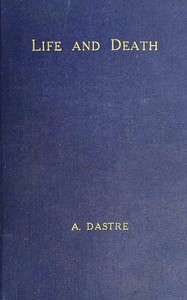
Life and death — Text and Context
Edition facts
Life and death — Text and Context can be approached with a clearer sense of reading commitment from its source measurements: 100,266 words, 7 hr 16 min estimated reading time, and 40 detected text sections.
The text analysis averages about 19.8 words per sentence, while the detected sections provide another way to judge how the source is divided.
Project Gutenberg metadata also associates the work with “Life (Biology),” connecting these edition facts with the source record’s subject description.
Calculated from edition completeness, EPUB availability, text structure and catalogue metadata. Not a user rating.
How this score is calculated
- Description quality20 pts
- Title & short description10 pts
- Source metadata20 pts
- Text length15 pts
- Chapters / structure15 pts
- EPUB file integrity20 pts
Total of 100 points, scaled to a 2.5-5.0 range. Editions with an empty description or a missing EPUB file are not scored.
Public-domain source text
Read the source text
The source text is kept in the dedicated reader, separate from this catalogue record and its commentary.
The preface of A. Dastre's Life and Death immediately establishes the book's ambition: to offer a 'royal road' to science through what the author calls 'Scientific Philosophy.' Dastre addresses two audiences—general readers seeking the 'trend of ideas in biology' and specialists interested in the principles and future of their field. This dual aim shapes the entire work, as the opening chapters move swiftly from a critique of vitalist theories to a detailed exposition of the extrinsic conditions necessary for life. The translator, W. J. Greenstreet, preserves Dastre's confident, lecture-like tone, which often invokes authorities such as Auguste Comte and Claude Bernard to support arguments.
The Preface as a Methodological Roadmap
Dastre's preface does more than introduce the book; it lays out a clear methodological stance. He compares the difficulty of learning science to Ptolemy's struggle with Euclid, then declares that 'royal roads' now exist in the form of scientific philosophy. This philosophy, he argues, 'throws light on facts' and 'replaces contingent details by essential facts.' The preface thus prepares readers for a text that will prioritize general truths over laboratory techniques. Dastre explicitly states his intention to address both 'readers of general culture' and fellow scientists, a balancing act that shapes the book's structure. The opening pages signal that the work will be argumentative, not merely descriptive, as Dastre positions himself against older vitalist traditions.
The Opening Argument Against Vitalism
In the first chapter, Dastre directly challenges the idea that life results from an 'internal demon' or vital force. He instead presents vital phenomena as 'a reaction of the environment,' quoting Auguste Comte's assertion that life requires 'an appropriate organism and a suitable environment.' This is not a neutral survey but a polemical move: Dastre credits Claude Bernard with dealing 'a mortal blow at the old vitalist theories' by showing that every vital manifestation depends on both extrinsic and intrinsic factors. The language is decisive—'the exact opposite is true'—and the argument is supported by references to protozoans and metazoans. Readers should note how Dastre uses historical figures to build his case, treating the history of physiology as a progressive rejection of vitalism.
The Four Extrinsic Conditions of Life
Dastre identifies four fundamental extrinsic conditions for life: moisture, oxygen, heat, and a specific chemical constitution of the medium. He emphasizes their 'remarkable uniformity' across species, a claim that undercuts the notion of life's infinite variability. The discussion is systematic: each condition is briefly explained, with the chemical constitution receiving particular attention as 'more precise if we look at it a little closer.' This section exemplifies Dastre's method of reducing complex phenomena to essential principles. The focus on external stimuli aligns with his broader argument that life is not spontaneous but requires provocation. Readers should observe how Dastre moves from abstract philosophy to concrete conditions, a pattern that recurs throughout the book.
The Role of Irritability in Dastre's Framework
A key concept introduced early is 'irritability,' defined as the living matter's 'faculty of entering into action when an external stimulus provokes it.' Dastre uses this term to argue that life is 'not solely an internal attribute, but an internal principle of action.' This distinction is crucial: it allows him to reject vitalism while still acknowledging the organism's active role. The discussion of irritability bridges the extrinsic and intrinsic factors, showing how they interact. Dastre's phrasing—'this being possesses no initiative or spontaneity in itself'—is deliberately provocative, challenging common intuitions about life. The concept reappears later in the book, making this early definition essential for understanding Dastre's overall argument. Readers should track how irritability functions as a unifying theme.
Dastre's Life and Death rewards readers who attend to its philosophical architecture. The preface and opening chapters establish a clear argumentative trajectory: from the rejection of vitalism to the identification of extrinsic conditions and the concept of irritability. Later sections likely develop these ideas, applying them to specific physiological processes. For a first reading, focus on how Dastre uses historical authorities and systematic reasoning to build his case. The book is best approached as a sustained argument rather than an encyclopedia, with each chapter advancing the central thesis that life is a reaction to the environment.
This preface reminds me of sitting with my grandfather's old biology textbook, the way it framed life as a quiet negotiation between what's inside us and what surrounds us. I felt that same hush reading Radioisotopes and Life Processes (Revised) — Themes and Context, where invisible tracers map our inner terrain. Both books share that gentle patience, letting big questions settle slowly rather than rushing to answers.
There are no reviews for this eBook.
How will you remember this book?
Save your reaction, strongest insight, and memorable passage.