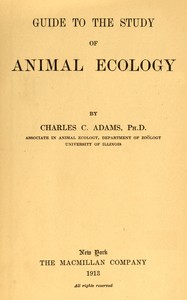
Guide to the study of animal ecology — Context and Discussion
Edition facts
Before opening Guide to the study of animal ecology — Context and Discussion, the edition data offers a quick orientation: 46,161 words, 3 hr 21 min estimated reading time, and 28 detected text sections.
The text analysis averages about 16.8 words per sentence, while the detected sections provide another way to judge how the source is divided.
Project Gutenberg metadata also associates the work with “Animal ecology,” connecting these edition facts with the source record’s subject description.
Calculated from edition completeness, EPUB availability, text structure and catalogue metadata. Not a user rating.
How this score is calculated
- Description quality20 pts
- Title & short description10 pts
- Source metadata20 pts
- Text length15 pts
- Chapters / structure15 pts
- EPUB file integrity20 pts
Total of 100 points, scaled to a 2.5-5.0 range. Editions with an empty description or a missing EPUB file are not scored.
Public-domain source text
Read the source text
The source text is kept in the dedicated reader, separate from this catalogue record and its commentary.
Charles C. Adams's Guide to the Study of Animal Ecology (1913) opens with a preface that frames the book as a response to the “almost bewildering number of facts” accumulating in zoological literature. Rather than an exhaustive treatise, Adams offers a “method of approach” and an “ecological point of view” that prioritizes process and sequence. The excerpts show a strong emphasis on behavior as a dynamic interplay between organism and environment, with Adams arguing that laboratory studies must be “checked up by constant appeal to nature” to avoid misleading conclusions. This editorial note examines the language, narrative voice, and shifts in pace that characterize the work.
A Voice of Pragmatic Caution
Adams’s prose is direct and often skeptical of overly confident laboratory science. In a passage quoting C. W. Hargitt, he questions the validity of conclusions drawn from animals “rudely taken from its natural habitat” and confined to a “finger-bowl.” The tone is measured but pointed, using rhetorical questions to challenge assumptions: “What right has one to assume…?” This voice recurs throughout the excerpts, blending instructional authority with a plea for methodological humility. Adams does not dismiss lab work—he calls it “indispensable”—but insists on its limitations, creating a narrative that balances advocacy with caution.
Pacing Through Quotation and Synthesis
The text’s pace shifts noticeably when Adams integrates extended quotations from other researchers. In the behavior section, a long block from Hargitt (1912) is followed by a shorter one from C. O. Whitman (1899), then a summary by Holmes (1905). These quotations slow the reading, giving weight to external voices before Adams reasserts his own synthesis: “The precedence here given to changes in behavior is in harmony with the emphasis which is put upon processes and genetic phases.” This alternation between quoted material and authorial commentary creates a rhythm of evidence and interpretation, typical of early 20th-century scientific writing.
Language of Process and Intergradation
Adams repeatedly uses terms like “sequences,” “genetic phases,” “intergradations,” and “relatively stable” versus “relatively changing” elements. This vocabulary reflects his ecological framework: behavior and environment are not fixed but exist on a continuum. He describes “two avenues of approach” (trial-and-error vs. tropisms) and “four variables” (two changing, two stable) that must be correlated. The language is precise but not overly technical, aiming to equip the beginner with conceptual tools. The recurring emphasis on “change” and “process” gives the prose a forward momentum, aligning with the book’s goal of teaching a dynamic, observational science.
Readers approaching Adams’s guide should attend to how he weaves together methodological critique, quoted authorities, and process-oriented terminology. The book is not a static reference but an argument for a particular way of seeing ecological relationships—one that values field observation and acknowledges the provisional nature of laboratory findings. The excerpts suggest a work that rewards careful reading of its prefatory and theoretical sections, where Adams’s voice is most distinct.
There’s something about Adams’s insistence on watching animals in their real, changing world that stayed with me long after closing it—that patient attention to process over result. It reminded me of the quiet ache in Life and death — Text and Context, where endings aren’t tidy conclusions but part of a longer, slower rhythm. Both left me sitting still, just thinking.
There are no reviews for this eBook.
How did this book work for you?
Your answers remain private and are stored only in this browser.