Radioisotopes and Life Processes (Revised) — Themes and Context

(0 User reviews)   186
In Category - Ecology
Kisieleski, Walter E., 1920-2011, Baserga, Renato, 1925-2023 Project Gutenberg 2015 Not confirmed
Biology; Radioactive tracers Readers of public-domain and historical texts
Project Gutenberg digital edition en

Edition facts

Words 16,695
Reading time 73 min
Text sections 3

This digital edition of Radioisotopes and Life Processes (Revised) — Themes and Context is described by source-level measurements including 16,695 words, 1 hr 13 min estimated reading time, and 3 detected text sections.

The text analysis averages about 20.5 words per sentence, while the detected sections provide another way to judge how the source is divided.

Project Gutenberg metadata also associates the work with “Biology,” connecting these edition facts with the source record’s subject description.

This booklet from the Understanding the Atom series explains how radioactive isotopes serve as tracers to study DNA, RNA, and protein synthesis, detailing laboratory methods like liquid scintillation counting and phenol extraction without assuming prior knowledge of nuclear science.
Share
Editorial Edition Score 4.5/5

Calculated from edition completeness, EPUB availability, text structure and catalogue metadata. Not a user rating.

How this score is calculated
  • Description quality20 pts
  • Title & short description10 pts
  • Source metadata20 pts
  • Text length15 pts
  • Chapters / structure15 pts
  • EPUB file integrity20 pts

Total of 100 points, scaled to a 2.5-5.0 range. Editions with an empty description or a missing EPUB file are not scored.

Edition quality

Public-domain source text

Read the source text

The source text is kept in the dedicated reader, separate from this catalogue record and its commentary.

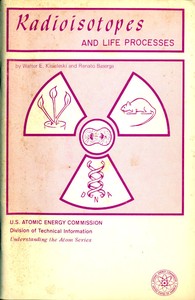
The booklet opens with a striking cover design that superimposes a dividing cell, a plant, an animal, and a DNA double helix onto a radiation trefoil, visually asserting the interrelationship of nuclear energy and biology. Published by the U.S. Atomic Energy Commission, it is part of the Understanding the Atom series, aimed at helping citizens grasp nuclear energy's role in daily life. The authors, Walter E. Kisieleski and Renato Baserga, bring complementary expertise: Kisieleski from Argonne National Laboratory and Baserga from Temple University Medical School. Their preface frames the work as a public education tool, not a specialist monograph.

From Cell Theory to Molecular Detectives

The booklet's chapter progression mirrors a logical ascent from cell theory to molecular mechanisms. Chapter 1, "Cell Theory: DNA Is the Secret of Life," establishes the central dogma, while Chapter 2, "Radioactive Isotopes: The Biological Detectives," introduces isotopes as tools. This detective metaphor recurs throughout: isotopes are used to "label" molecules and trace their fate. The authors emphasize that radioactive precursors, such as tritiated thymidine, become incorporated into newly synthesized DNA, allowing researchers to measure synthesis rates. The text is careful to distinguish between types of radioactivity—alpha, beta, gamma—and their detection methods, grounding abstract concepts in concrete laboratory practice.

The Craft of Counting: Liquid Scintillation and Its Quirks

A detailed description of liquid scintillation counting reveals the booklet's practical bent. The authors explain how a radioactive sample mixed with a liquid scintillator produces photon bursts that a photomultiplier tube converts into electrical pulses. They note advantages—ease of sample preparation—and disadvantages: different compounds cause varying degrees of quenching, and the best scintillating solvents are poor chemical solvents for biological materials. The low operating temperatures exacerbate solubility issues. These frank admissions of technical limitations are characteristic of the series' educational approach, presenting science as a set of workable compromises rather than a frictionless process.

Separating the Alphabet Soup of RNA

When discussing RNA analysis, the authors detail phenol extraction to isolate native RNA, then ultracentrifugation in concentrated sugar solution to separate components by molecular weight. They identify three major fractions: s-RNA (lightest), r-RNA (with two subfractions), and m-RNA, which is difficult to detect without radioactive labeling due to its scarcity. The base composition analysis—digesting RNA to mononucleotides and quantifying guanine, adenine, cytosine, and uracil—is presented as a quantitative tool. The text notes that three bases are shared with DNA, but thymidine is replaced by uracil, a key distinction. This section exemplifies the booklet's method: step-by-step protocols paired with conceptual explanations.

Readers should approach this booklet as a primer that assumes no prior knowledge of nuclear physics or molecular biology, yet does not oversimplify the experimental challenges. The authors consistently tie each technique back to a biological question—how fast is RNA synthesized? What kind of RNA is it?—making the methods feel purposeful. The final chapter on cancer research hints at clinical applications, but the core value lies in its clear, honest depiction of mid-1960s laboratory practice.

I remember shelving Radioisotopes and Life Processes and thinking how its careful, uniform tracers revealed the quiet work of cells. This other—The genetic and the operative evidence relating to secondary sexual characters — Key Ideas to Explore—holds a similar patience. Both trust small, visible clues to hint at grander hidden mechanisms. They share a reverence for evidence, as if whispering the same old secret: nature explains itself slowly, if we only look. That kinship has stayed with me.

There are no reviews for this eBook.

0
0 out of 5 (0 User reviews )

Add a Review

Your Rating *
There are no comments for this eBook.

Reader reflection

Your personal reading reflection

Build a private reading journal entry for this title.

Your progress 0 / 10
1

How far have you progressed with this book?

2

What was your overall reaction to the book?

3

How likely are you to recommend this book?

4

How much effort did this book require?

Related eBooks