A bacteriological study of ham souring — A Closer Reading
Edition facts
A bacteriological study of ham souring — A Closer Reading can be approached with a clearer sense of reading commitment from its source measurements: 26,459 words, 1 hr 56 min estimated reading time, and 14 detected text sections.
The text analysis averages about 24.6 words per sentence, while the detected sections provide another way to judge how the source is divided.
Project Gutenberg metadata also associates the work with “Ham -- Microbiology,” connecting these edition facts with the source record’s subject description.
Calculated from edition completeness, EPUB availability, text structure and catalogue metadata. Not a user rating.
How this score is calculated
- Description quality20 pts
- Title & short description10 pts
- Source metadata20 pts
- Text length15 pts
- Chapters / structure15 pts
- EPUB file integrity20 pts
Total of 100 points, scaled to a 2.5-5.0 range. Editions with an empty description or a missing EPUB file are not scored.
Public-domain source text
Read the source text
The source text is kept in the dedicated reader, separate from this catalogue record and its commentary.
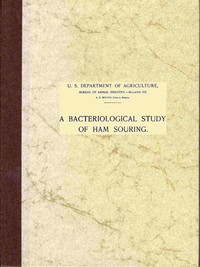
This 1911 bulletin from the U.S. Department of Agriculture’s Bureau of Animal Industry presents a focused bacteriological investigation into a specific industrial problem: the souring of hams during curing. Author C. N. McBryde, a senior bacteriologist, systematically isolates an anaerobic bacillus from sour hams and then tests its pathogenicity through controlled injection experiments. The work is notable for its clear experimental design, including the use of egg-pork culture media and the distinction between hams pumped in the shank only versus those pumped in both body and shank. The catalog subject “Ham – Microbiology” accurately reflects the content, though the secondary topic “agriculture-gardening” is misleading; this is a meat-science and food-safety document, not a gardening text.
Experimental Design and Inoculation Methods
McBryde’s experiments hinge on a simple but rigorous protocol. He isolates a bacillus from naturally soured hams, cultivates it in an egg-pork medium, and injects measured doses into sound hams. Two experiments are described, varying the injection volume and the pumping method. In Experiment I, hams pumped only in the shank received 2.5 cubic centimeters of culture; in Experiment II, the dose was increased to 10 cubic centimeters. The key variable is whether the ham is also pumped in the body, which introduces pickling fluid directly to the injection site. The results are stark: of 40 hams pumped only in the shank, 39 (97.5 percent) soured, while only 22 of 40 (55 percent) pumped in both body and shank soured. This differential strongly suggests that the pickling brine inhibits the bacillus when brought into immediate contact.
The Bacillus and Its Identification
McBryde’s central claim is that the anaerobic bacillus he isolated is “an undoubted cause” of ham souring. He supports this with two lines of evidence: the bacillus was “constantly present” in naturally soured hams, and it was the only organism from such hams that produced “the characteristic sour-ham odor” in egg-pork cultures. Notably, he does not name the species—the text refers to it simply as “the anaerobic bacillus” or “the ham-souring bacillus.” This restraint reflects the era’s taxonomic limitations. The bulletin also rules out pre-slaughter infection: fresh, unmanipulated hams yielded no such bacillus. The implication is that contamination occurs during handling, not from the live animal.
Practical Implications for the Packing Industry
The bulletin’s closing sections address prevention and disposal, though the excerpts are incomplete. The letter of transmittal from Bureau Chief A. D. Melvin notes that the paper discusses “methods of preventing the souring of hams and the proper disposal of those which have become affected.” The experimental data already suggest a practical measure: thorough pumping of the body with pickling brine can reduce souring rates. The finding that shank-only pumping leads to nearly universal souring when the bacillus is present points to a specific vulnerability in curing practice. For the modern reader, the bulletin offers a window into early 20th-century food-safety research, where a single bacterial agent could be isolated and linked to a costly industrial problem through straightforward experimentation.
Readers should note that this is a government bulletin, not a commercial publication, and its language reflects early 20th-century scientific prose. The excerpts provide a clear view of the experimental core but omit the full discussion of prevention and disposal methods. Those interested in the history of food microbiology or the development of USDA research will find this a concise case study in applied bacteriology. The work stands on its own as a record of how a specific spoilage organism was identified and its role confirmed through controlled trials.
That afternoon, rain blurred the window while I traced McBryde’s careful experiments, his quiet proof of cause and effect. Souring ham, a hidden world. Later, I found myself thinking about renewal, how things repair themselves. I reached for Regeneration — A Closer Reading, and the rain kept falling, gently, as if it understood.
There are no reviews for this eBook.
How did this book work for you?
Your answers remain private and are stored only in this browser.