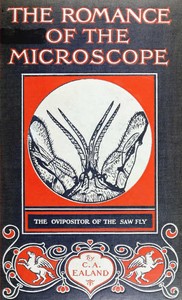
The Romance of the Microscope An interesting description of its uses in all branches of science, industry, agriculture, and in the detection of crime, with a short — Inside the Classic

(0 User reviews)   186
In Category - Microscopy
Ealand, C. A. (Charles Aubrey), 1877- Project Gutenberg 2015 Not confirmed
Microscopy; Microscopes Readers of public-domain and historical texts
Project Gutenberg digital edition en

Edition facts

Words 84,823
Reading time 369 min
Text sections 35

For The Romance of the Microscope An interesting description of its uses in all branches of science, industry, agriculture, and in the detection of crime, with a short — Inside the Classic, the stored edition analysis reports 84,823 words, 6 hr 9 min estimated reading time, and 35 detected text sections.

The text analysis averages about 21.8 words per sentence, while the detected sections provide another way to judge how the source is divided.

Project Gutenberg metadata also associates the work with “Microscopy,” connecting these edition facts with the source record’s subject description.

An early 20th-century guide to microscopy that moves from instrument basics to applications in farming, crime detection, and natural history, using concrete seed descriptions and a conversational tone to teach identification.
Share
Editorial Edition Score 4.9/5

Calculated from edition completeness, EPUB availability, text structure and catalogue metadata. Not a user rating.

How this score is calculated
  • Description quality20 pts
  • Title & short description10 pts
  • Source metadata20 pts
  • Text length15 pts
  • Chapters / structure15 pts
  • EPUB file integrity20 pts

Total of 100 points, scaled to a 2.5-5.0 range. Editions with an empty description or a missing EPUB file are not scored.

Edition quality

Public-domain source text

Read the source text

The source text is kept in the dedicated reader, separate from this catalogue record and its commentary.

C. A. Ealand’s The Romance of the Microscope opens not with a dry treatise on lenses but with a catalog of popular science books, placing itself firmly in a series that promised accessible, illustrated explanations. The author’s approach becomes clear in the seed chapter: he defines a weed as “a plant in the wrong place,” then guides the beginner through collecting and naming seeds by starting with familiar flowers. The prose is direct and practical, warning that distinguishing white from red campion seeds—both “kidney shaped seeds studded with warts”—requires real expertise.

A Practical Start with Seeds

The excerpt on farm seeds reveals Ealand’s method: he assumes no prior knowledge, recommending only “a powerful magnifying glass” to begin. He acknowledges the immediate difficulty of naming seeds without an expert, then offers a workaround—collect seeds from known flowers to build a reference set. The descriptions are precise and visual: corn buttercup seeds are “spined,” larkspur seeds appear “studded with little shreds of paper,” and cornflower seeds resemble “little shaving-brushes, with bright yellow bristles.” This concrete language makes identification feel achievable, while the warning that distinguishing clover species requires “much more experience” keeps expectations realistic.

Parasites and the Farmer’s Enemy

Ealand introduces two parasitic plants—broomrape and dodder—with a moral tone: they are “unable to earn their own living.” He explains that broomrape attaches to tree roots or clover, while dodder, a member of the Convolvulus family, germinates as a “seedling not unlike a piece of wire” that waves until it finds a clover plant. The description of dodder’s suckers penetrating the clover stem is vivid, and he suggests pulling the dodder away to see the holes left behind. This section blends botany with practical agriculture, showing how microscopy reveals the hidden mechanisms of crop damage.

Fungi as Thieves

The discussion of fungi continues the theme of theft: “the one invariable reason” fungi damage plants is that they “steal it from the plants on which they grow.” Ealand distinguishes parasites (living hosts) from saprophytes (dead matter), using white mould as a familiar example. The language is straightforward, avoiding technical jargon, and the logic is clear: understanding fungus structure begins with common moulds. This chapter positions the microscope as a tool for diagnosing agricultural problems, not just for academic curiosity.

Beyond the Farm: Crime and Industry

Though the excerpts focus on agriculture, the book’s full title promises applications in crime detection and industry. The opening pages list other volumes in the “Romance Library,” suggesting a consistent style: non-technical, illustrated, and aimed at a general audience. Ealand’s seed chapter demonstrates his ability to make specialized knowledge accessible—he describes shapes, textures, and comparisons (miniature dates, bananas, shaving-brushes) that any reader can visualize. This approach likely extends to later sections on microscopy in criminal investigation, where similar observational skills would be applied to fibers, bloodstains, or other trace evidence.

Ealand’s book rewards a first reading that follows his own advice: start with what you know. The seed chapter works as a self-contained lesson, but its methods—careful observation, comparison, and classification—recur throughout. Readers new to microscopy will find the concrete descriptions more useful than abstract theory. The book’s structure, moving from simple magnifiers to practical applications, mirrors the gradual skill-building Ealand recommends for seed identification.

I’ve often set the practical little guide beside my worn copy of Essays on the Microscope Containing a Practical Description of the Most Improved Microscopes, a General History of Insects, etc., etc. — Inside the Classic, sensing how the later book quietly nods to the earlier one—both trusting the same patient wonder, the same unhurried eye.

There are no reviews for this eBook.

0
0 out of 5 (0 User reviews )

Add a Review

Your Rating *
There are no comments for this eBook.

Reader reflection

How did this book work for you?

Your answers remain private and are stored only in this browser.

Your progress 0 / 10
1

Have you finished this book?

2

Was reading this book enjoyable?

3

How likely are you to recommend this book?

4

How much effort did this book require?

Related eBooks