History of biology — Inside the Classic
Edition facts
Before opening History of biology — Inside the Classic, the edition data offers a quick orientation: 42,009 words, 3 hr 3 min estimated reading time, and 15 detected text sections.
The text analysis averages about 22.2 words per sentence, while the detected sections provide another way to judge how the source is divided.
Project Gutenberg metadata also associates the work with “Biology -- History,” connecting these edition facts with the source record’s subject description.
Calculated from edition completeness, EPUB availability, text structure and catalogue metadata. Not a user rating.
How this score is calculated
- Description quality20 pts
- Title & short description10 pts
- Source metadata20 pts
- Text length15 pts
- Chapters / structure15 pts
- EPUB file integrity20 pts
Total of 100 points, scaled to a 2.5-5.0 range. Editions with an empty description or a missing EPUB file are not scored.
Public-domain source text
Read the source text
The source text is kept in the dedicated reader, separate from this catalogue record and its commentary.
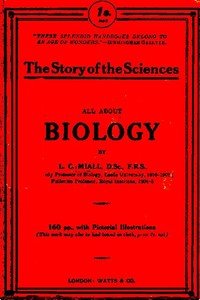
Miall organizes the history of biology into five periods, from 1530 to 1859 and later, each introduced by a list of characteristic themes. The excerpts show a strong emphasis on plant morphology and the gradual understanding of reproductive structures, culminating in the discovery of seed-bearing fossil plants like Lyginodendron. The catalog subject 'Biology -- History' is accurate but broad; the text itself focuses heavily on botanical discoveries and the evolution of plant classification, with less attention to zoology or experimental physiology than the table of contents might suggest.
Plant Morphology as a Thread
The excerpts devote considerable space to the metamorphosis of plants, tracing ideas from Cesalpini (1583) through Linnæus, Wolff, Goethe, and Hofmeister to Oliver and Scott (1904). Miall presents a cumulative narrative: each investigator added a piece to the puzzle of how floral organs relate to leaves. The discussion is technical, using terms like 'sporophylls' and 'sporangia' without extensive glossing, assuming a reader familiar with basic botany. Notably, Miall critiques Goethe's ideal plant as insufficient, arguing that asexual plants cannot be complex. This section demonstrates that the book is not merely a chronological list but an argument about the progress of morphological understanding.
Fossil Evidence and Evolutionary Inference
Miall highlights the carboniferous plant Lyginodendron, which 'bore true seeds, as a pine or a cycad does' while showing 'unmistakable affinity with the ferns.' This discovery by Oliver and Scott is presented as a key step toward identifying the cryptogamic ancestor of flowering plants. The author uses such fossil evidence to correct earlier theories, particularly the notion that stamens and pistils derive directly from foliage leaves. Instead, Miall argues that the sporangium is the essential part, and the supporting leaf is 'only an accessory.' This careful use of paleobotany to refine morphological theory is a distinctive feature of the work.
Structure and Scope of the Narrative
The book's structure is period-based, with each era introduced by a list of 'characteristics' and then explored through key figures and discoveries. The excerpts show that Miall integrates primary sources, such as references to Cesalpini (1583) and Hofmeister (1849-57), and includes a chronological table and bibliography. However, the excerpts do not reveal how the book handles zoology or the later period on Darwin and Pasteur. The catalog subject 'Microscopy' is not evident in the provided text; the focus is on macroscopic plant structures and fossil evidence. Readers should expect a work that is more botanical than the title 'History of Biology' implies, and one that assumes prior knowledge of biological terms.
Miall's history is best approached as a specialized account of botanical morphology and its development, rather than a comprehensive survey of all biology. Readers with a background in plant anatomy will find the technical discussions rewarding, while those seeking general history may need supplementary sources. The book's value lies in its detailed tracing of how specific discoveries—from Cesalpini's leaf identifications to Oliver and Scott's fossil seeds—reshaped understanding of plant evolution.
Miall's patient tracing of life's slow unfolding, branch by fossil branch, always reminds me of another book's quiet devotion—the way a hand once turned a lens to a gnat's wing. That same careful wonder lives in Essays on the Microscope Containing a Practical Description of the Most Improved Microscopes, a General History of Insects, etc., etc. — Inside the Classic, a gentler sibling to that older lineage.
There are no reviews for this eBook.
How will you remember this book?
Save your reaction, strongest insight, and memorable passage.