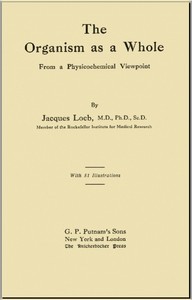
The Organism as a Whole, from a Physicochemical Viewpoint — Reading Companion
Edition facts
This digital edition of The Organism as a Whole, from a Physicochemical Viewpoint — Reading Companion is described by source-level measurements including 96,316 words, 6 hr 59 min estimated reading time, and 18 detected text sections.
The text analysis averages about 19.9 words per sentence, while the detected sections provide another way to judge how the source is divided.
Project Gutenberg metadata also associates the work with “Biology,” connecting these edition facts with the source record’s subject description.
Calculated from edition completeness, EPUB availability, text structure and catalogue metadata. Not a user rating.
How this score is calculated
- Description quality20 pts
- Title & short description10 pts
- Source metadata20 pts
- Text length15 pts
- Chapters / structure15 pts
- EPUB file integrity20 pts
Total of 100 points, scaled to a 2.5-5.0 range. Editions with an empty description or a missing EPUB file are not scored.
Public-domain source text
Read the source text
The source text is kept in the dedicated reader, separate from this catalogue record and its commentary.
Jacques Loeb opens The Organism as a Whole by confronting a central tension: individual physiological processes are accepted as physicochemical, yet the organism’s harmonious integration often prompts doubts about the sufficiency of such a viewpoint. He notes that Mendelian heredity, with its independent transmission of characters, seems to reduce the organism to a mosaic of separate traits, raising the question of what molds them into a coherent whole. Loeb explicitly rejects vitalist appeals to pre-established design or guiding principles, and he finds natural selection incomplete because it ignores the physicochemical constitution of living matter. The excerpts reveal a sustained effort to bring specific experimental evidence—from sex determination in worms and crabs to the effects of parasitic castration—to bear on this problem, always insisting on chemical and physical mechanisms rather than teleological explanations.
Mendelian Mosaics and the Problem of Unity
Loeb takes Mendelian heredity as a serious challenge to the idea of the organism as a whole. He writes that “each character is transmitted independently of any other character,” and because the number of such characters is large, “the possibility must be faced that the organism is merely a mosaic of independent hereditary characters.” This is not a casual observation; it frames the book’s central question. Rather than accepting the mosaic as a final description, Loeb insists that a physicochemical account must explain how independent units become integrated. He does not dismiss Mendelism but uses it to sharpen the problem. The excerpts show that he seeks mechanisms—such as chemical substances or developmental conditions—that coordinate characters, rather than invoking a mysterious coordinating force. This approach sets his work apart from both vitalist and purely selectionist explanations.
Chemical Signals and Sexual Transformation
A striking pattern in the excerpts is Loeb’s use of sex determination as a test case for physicochemical integration. He describes experiments on Bonellia larvae, where a substance from the female’s proboscis can suppress male tendencies and accelerate development into a male. He writes that “the tendency for both sexual characters is present” in all larvae, and that “certain chemical substances which the larva may take up” can influence which set develops. Similarly, he discusses parasitic castration in crabs: the parasite Sacculina transforms male secondary sexual characters into female ones, and G. Smith found that this transformation is accompanied by changes in blood fatty constituents, making them equal to those of females. Loeb also notes that in old females of birds and mammals, male secondary characters appear when sexual glands cease to function. These examples are not mere curiosities; they serve as evidence that chemical changes can orchestrate the expression of whole suites of characters, supporting his physicochemical view.
Experimental Embryology and the Role of Anastomosis
Loeb’s argument extends to developmental mechanics. He discusses F. Lillie’s work on free-martin cattle, where twins of different sex result in a sterile female. Lillie discovered that the two embryos’ blood vessels anastomose in the chorion, allowing exchange of substances. Loeb presents this as a case where “the blood-vessels from each side then anastomose” and “a particularly wide arterial anastomosis develops,” so that hormones or other factors from the male twin can influence the female’s development. This is a concrete, physicochemical mechanism for altering sexual differentiation. Throughout the excerpts, Loeb consistently selects experiments that reveal how physical connections or chemical gradients shape the organism. He avoids abstract vital forces and instead points to measurable processes—blood composition, secreted substances, vascular fusions—as the agents of integration. The cumulative effect is a portrait of the organism as a system of interacting chemical and physical events, not a mosaic of independent parts.
Readers should approach The Organism as a Whole as a sustained argument for extending physicochemical analysis to the most integrative aspects of life. Loeb does not claim to have solved the problem of unity, but he provides a method: look for chemical and physical interactions that coordinate parts. The book is richest when it moves between theoretical challenges—like Mendelian independence—and concrete experimental cases, such as sex reversal or embryonic fusion. Pay attention to how Loeb uses each example to undermine vitalist or purely descriptive accounts, and note where he acknowledges gaps. His dedication to Diderot signals a materialist tradition, but the science is specific and often surprising.
There’s something gentle about Loeb’s insistence that unity isn’t mystical, just intricate—like remembering an old teacher’s quiet faith in detail. That same patience lingers in the practical pages of Section Cutting and Staining A practical introduction to histological methods for students and practitioners — Reading Companion, where slicing tissue becomes a small act of reverence, not just procedure. I sometimes miss that unhurried care.
There are no reviews for this eBook.
Take a moment to reflect on this book
Create a short personal record of your experience with this book.