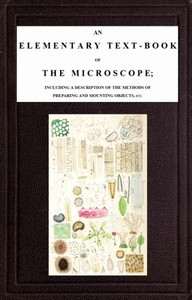
An Elementary Text-book of the Microscope including a description of the methods of preparing and mounting objects, etc. — Reading Notes

(0 User reviews)   1155
In Category - Microscopy
Griffith, J. W. (John William) Project Gutenberg 2015 Not confirmed
Microscopy Readers of public-domain and historical texts
Project Gutenberg digital edition en

Edition facts

Words 64,731
Reading time 282 min
Text sections 10

The source record for An Elementary Text-book of the Microscope including a description of the methods of preparing and mounting objects, etc. — Reading Notes measures this digital text at 64,731 words, 4 hr 42 min estimated reading time, and 10 detected text sections.

The text analysis averages about 19.0 words per sentence, while the detected sections provide another way to judge how the source is divided.

Project Gutenberg metadata also associates the work with “Microscopy,” connecting these edition facts with the source record’s subject description.

J. W. Griffith's 1864 microscopy manual combines precise technical descriptions of specimen preparation with detailed observations of plant and fungal structures, emphasizing hands-on collection and the use of specific magnifying powers.
Share
Editorial Edition Score 4.8/5

Calculated from edition completeness, EPUB availability, text structure and catalogue metadata. Not a user rating.

How this score is calculated
  • Description quality20 pts
  • Title & short description10 pts
  • Source metadata20 pts
  • Text length15 pts
  • Chapters / structure15 pts
  • EPUB file integrity20 pts

Total of 100 points, scaled to a 2.5-5.0 range. Editions with an empty description or a missing EPUB file are not scored.

Edition quality

Public-domain source text

Read the source text

The source text is kept in the dedicated reader, separate from this catalogue record and its commentary.

J. W. Griffith opens his 1864 manual by declaring it "adapted rather for a worker than a reader," a statement that sets the tone for the entire volume. The preface immediately establishes a practical, no-nonsense approach: the reader is assumed to have no prior acquaintance with the microscope or natural history, yet is expected to collect specimens and prepare them independently. Griffith's diction is consistently direct and instructional, favoring concrete descriptions over figurative language. He warns that "the small size of the work has necessitated the exclusion of figurative descriptions," and indeed the text is dense with technical terms, each explained and often given with derivations to aid memory.

A Worker's Vocabulary

Griffith's linguistic choices reveal a deliberate pedagogical strategy. He introduces Latin binomials and specialized terms like spermogonia, sterigmata, and apiculate alongside plain-English explanations. For instance, he describes Phragmidium bulbosum spores as "from 2- to 4-septate, and stalked, the stalks being swollen or bulbous at the base." The technical term tuberculate is immediately glossed as "covered with little knobs." This pattern—term, then clarification—appears throughout, building a reader's lexicon incrementally. The preface notes that technical terms are indexed "to furnish to some extent a glossary," and derivations are given to "facilitate their recollection." The result is a text that teaches its own language, enabling the novice to eventually consult more advanced works.

Seeing Through the Lens

Griffith repeatedly emphasizes the critical role of magnifying power in observation. Beneath each figure, a small number denotes the power used, and he insists that "the particular attention of the reader is requested to this point; otherwise the whole subject will be utterly confused." This is not a casual remark: he warns that "so much does the appearance of objects vary under different powers." In describing Uredo segetum (smut), he notes that spores appear "brown and faintly dotted" under the microscope, the dots arising from "a reticulated structure of the surface, similar to that of the poppy-seed on a very small scale." Such analogies ground microscopic observation in familiar visual experience, while the constant reference to power numbers trains the reader to correlate scale with appearance.

Fungal Forms and False Capsules

A recurring structural observation concerns the distinction between true and spurious capsules. In discussing Uredo species, Griffith notes that the spots (sori) often "exhibit a thin membrane covering the spores, which bursts down the middle, so as to bear some resemblance to a capsule." He then clarifies: "But there is no true capsule, the membrane consisting of the epidermis of the leaf or stalk of the plant, which is raised and torn by the expansion of the growing fungus." This careful parsing of appearance versus reality is typical. Similarly, he explains that the so-called species of Uredo are not truly distinct but are forms of Puccinia or Phragmidium—a taxonomic nuance that underscores the complexity of fungal life cycles. The descriptions are consistently precise about what is observed and what it signifies.

The Collector's Craft

Griffith's manual is as much about preparation as observation. He directs readers to collect specimens themselves, calling this "the best method of acquiring a practical and useful acquaintance with the objects." The preface states that directions for preparing and mounting objects are given, implying that the reader will gather samples from nature. In the fungal descriptions, he notes common host plants—nettle, barberry, dandelion—and provides recognizable features like the pods of Shepherd's Purse ("easily recognized by the form and arrangement of the pods"). This practical orientation extends to the plates: figures are "drawn from nature" and coloured for easy recognition. The text thus functions as a field guide and laboratory manual combined, training the eye and hand simultaneously.

Griffith's text rewards careful reading: its dense, technical prose mirrors the precision required at the microscope. Readers should pay close attention to the magnifying powers noted for each figure, as these are essential for accurate identification. The manual's value lies not in narrative but in its systematic building of observational skill—a quality that makes it as useful today for historical perspective as it was for Victorian naturalists.

I remembered my grandfather’s hands, steadying a slide under lamplight, the way his patience made the invisible gentle. Griffith’s careful world of mounting and magnifying felt familiar, but then I recalled another quiet afternoon with Common objects of the microscope — Inside the Classic, where similar wonder spread unhurriedly, like dust in a beam of afternoon sun.

There are no reviews for this eBook.

0
0 out of 5 (0 User reviews )

Add a Review

Your Rating *
There are no comments for this eBook.

Reader reflection

How will you remember this book?

Save your reaction, strongest insight, and memorable passage.

Your progress 0 / 10
1

How far have you progressed with this book?

2

Did this book hold your interest?

3

Would you pass this book on to a friend?

4

How demanding did the text feel?

Related eBooks