Outlines of Creation — Inside the Classic

(0 User reviews)   1669
In Category - Natural History
Noyce, Elisha Project Gutenberg 2015 Not confirmed
Natural history -- Juvenile literature Readers of public-domain and historical texts
Project Gutenberg digital edition en

Edition facts

Words 85,982
Reading time 374 min
Text sections 17

For Outlines of Creation — Inside the Classic, the stored edition analysis reports 85,982 words, 6 hr 14 min estimated reading time, and 17 detected text sections.

The text analysis averages about 32.3 words per sentence, while the detected sections provide another way to judge how the source is divided.

Project Gutenberg metadata also associates the work with “Natural history -- Juvenile literature,” connecting these edition facts with the source record’s subject description.

Elisha Noyce's 1858 natural history for juveniles organizes the cosmos into sky, air, earth, waters, and plants, blending astronomical data, geological strata, and botanical taxonomy with moral overtones. The catalog subject 'Natural history -- Juvenile literature' fits, but the excerpts reveal a dense, technical work far exceeding simple children's fare.
Share
Editorial Edition Score 4.9/5

Calculated from edition completeness, EPUB availability, text structure and catalogue metadata. Not a user rating.

How this score is calculated
  • Description quality20 pts
  • Title & short description10 pts
  • Source metadata20 pts
  • Text length15 pts
  • Chapters / structure15 pts
  • EPUB file integrity20 pts

Total of 100 points, scaled to a 2.5-5.0 range. Editions with an empty description or a missing EPUB file are not scored.

Edition quality

Public-domain source text

Read the source text

The source text is kept in the dedicated reader, separate from this catalogue record and its commentary.

Elisha Noyce's Outlines of Creation (1858) opens not with a gentle invitation to wonder but with a table of contents that reads like a syllabus: 'Sky, definition of 1,' 'Stars, what they are 1,' 'Nebulæ 2.' The book's structure—five sections on the sky, air, earth, waters, and plants—mirrors a systematic survey of natural philosophy. Despite its cataloging as juvenile literature, the excerpts show a work that expects sustained attention: detailed descriptions of elliptical orbits, the composition of air, and the classification of plants into orders such as Amaryllidaceæ and Iridaceæ. The prose is factual, occasionally enlivened by curious facts—the Cape Blood-flower's use in poisoned arrows, or the orchid that mimics a swan. Noyce assumes a reader willing to follow technical explanations, not merely a child seeking entertainment.

A Catalogue of the Cosmos

The book's table of contents is itself a document of Victorian classification. Under 'The Sky' alone, Noyce lists forty-three subheadings, from 'Sun, probable planets of' to 'Comets.' The structure is relentlessly enumerative: each planet gets its own entry, each geological era its own stratum. The excerpts show that Noyce does not simply name phenomena but explains them—'Ellipse, definition of 5' precedes 'Earth's orbit, form of 6.' This pedagogical ordering suggests the book was used for systematic study, perhaps in a school or home library. The catalog subject 'Natural history -- Juvenile literature' is accurate, but the density of the table hints at a work that doubles as a reference manual. A child reading this would need patience; an adult might find it a useful digest of mid-century science.

Botany as a Moral and Practical Science

The botanical section, the longest in the excerpts, reveals Noyce's dual purpose: to instruct and to edify. He describes plant families with precision—'Exogenæ ... characterised by ... the twisted and branched form of the stem'—but also includes practical uses: orris-root sold at druggists, Zostera marina stuffed into mattresses. The moral dimension emerges in asides: the orchid family's 'curious fact' that flowers on the same stem can appear to belong to different genera is presented as a wonder of divine design. Noyce quotes Dr. Baird at length, integrating contemporary scientific authorities. This blend of taxonomy, utility, and awe aligns with the Victorian natural theology tradition, though the excerpts do not explicitly invoke a creator. The catalog subject does not capture this layered approach; the book is as much about how to see nature as about nature itself.

The Reader as Apprentice Naturalist

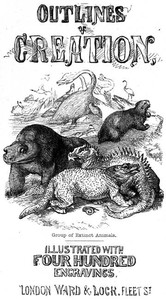
Noyce's prose assumes an active reader. He explains endosmose, the process by which roots absorb moisture, in a single sentence dense with technical terms: 'these, being formed of new porous cellular tissue, begin to absorb (by endosmose) the moisture of the earth.' No glossary is provided. The book's 400 engravings, credited to the Brothers Dalziel, are mentioned in the title page but not described in the excerpts; they likely served as visual anchors for the textual descriptions. The estimated reading time of 374 minutes suggests a substantial commitment. The catalog subject 'Natural history -- Juvenile literature' may understate the cognitive demands Noyce places on his young audience. The book rewards a reader willing to move slowly, cross-referencing the table of contents and the illustrations, treating the volume as a field guide to the entire created order.

Outlines of Creation is best approached not as a story but as a cabinet of curiosities in prose form. Readers will find it useful to follow the table of contents as a map, dipping into sections of interest rather than reading straight through. The book's value lies in its specificity—the exact number of Jupiter's satellites, the list of elements, the description of coal formation. For those curious about how a Victorian author translated the science of his day for a young audience, Noyce's work offers a detailed, unsentimental answer.

I found myself thinking of Elisha Noyce’s orderly cosmos—his careful strata of sky and water—while turning the pages of The Tropical World Aspects of man and nature in the equatorial regions of the globe. — Key Ideas to Explore. Both feel like someone’s patient hand, mapping the wild into familiar rooms. One keeps the heavens tidy; the other lets the heat and green spill over. A quiet kinship, perhaps.

There are no reviews for this eBook.

0
0 out of 5 (0 User reviews )

Add a Review

Your Rating *
There are no comments for this eBook.

Reader reflection

What did you think of this book?

Answer a few questions and save a private reflection on this device.

Your progress 0 / 10
1

Where are you in your reading?

2

Was reading this book enjoyable?

3

Would you encourage someone else to read it?

4

How easy was the book to follow?

Related eBooks