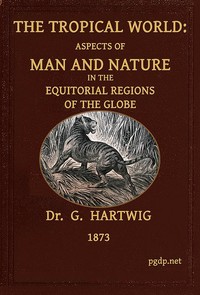
The Tropical World Aspects of man and nature in the equatorial regions of the globe. — Key Ideas to Explore

(0 User reviews)   130
In Category - Natural History
Hartwig, G. (Georg), 1813-1880 Project Gutenberg 2020 Not confirmed
Natural history -- Tropics; Tropics Readers of public-domain and historical texts
Project Gutenberg digital edition en

Edition facts

Words 226,273
Reading time 984 min
Text sections 55

This digital edition of The Tropical World Aspects of man and nature in the equatorial regions of the globe. — Key Ideas to Explore is described by source-level measurements including 226,273 words, 16 hr 24 min estimated reading time, and 55 detected text sections.

The text analysis averages about 29.7 words per sentence, while the detected sections provide another way to judge how the source is divided.

Project Gutenberg metadata also associates the work with “Natural history -- Tropics,” connecting these edition facts with the source record’s subject description.

Hartwig's 1873 natural history surveys tropical climates, landscapes, and wildlife through vivid, often dramatic prose. This edition's preface notes revisions and new chapters on human races. Excerpts show a narrative voice that blends scientific description with animated, almost literary accounts of animal encounters, such as the secretary bird's battle with a snake.
Share
Editorial Edition Score 4.9/5

Calculated from edition completeness, EPUB availability, text structure and catalogue metadata. Not a user rating.

How this score is calculated
  • Description quality20 pts
  • Title & short description10 pts
  • Source metadata20 pts
  • Text length15 pts
  • Chapters / structure15 pts
  • EPUB file integrity20 pts

Total of 100 points, scaled to a 2.5-5.0 range. Editions with an empty description or a missing EPUB file are not scored.

Edition quality

Public-domain source text

Read the source text

The source text is kept in the dedicated reader, separate from this catalogue record and its commentary.

Hartwig opens his survey of the tropical world not with a general definition but with a chapter on the diversity of climates within the tropics, immediately establishing a focus on variation rather than uniformity. The preface to this 1873 edition signals his method: he has revised earlier content and added chapters on human races, aiming to condense information within narrow limits. The excerpts reveal a narrative voice that oscillates between detached cataloguing—listing causes of rainfall, trade winds, monsoons—and animated, almost literary set-pieces, such as the secretary bird’s “obstinate” battle with a serpent, described through Le Vaillant’s quoted account.

A Voice That Shifts Between Catalogue and Drama

The prose in The Tropical World moves unpredictably between two registers. One is the patient enumerator: chapter titles list causes of rain, types of storms, and the sequence of seasons on the llanos. The other is a storyteller who lingers on conflict. In the secretary-bird passage, Hartwig surrenders the narration to Le Vaillant’s first-hand description, complete with direct speech (“The battle was obstinate”). The adjutant bird is introduced with a mock-heroic simile—“with measured step and slow, like a German philosopher”—before its feeding is likened to a merchant calculating gains. These tonal shifts are not signalled; they simply occur, suggesting that Hartwig saw no firm boundary between natural-historical fact and narrative embellishment.

Pace as a Tool for Emphasis

Hartwig controls pace by alternating rapid inventories with slowed, detailed scenes. The chapter on the llanos moves briskly through dry-season dust, sand-spouts, and mirage effects, then decelerates for the “miraculous changes” of the rainy season. A similar pattern appears in the serpent section: a quick list of snake enemies (ostrich, secretary bird) gives way to the prolonged, blow-by-blow account of the secretary bird’s combat. The adjutant’s feeding is narrated in a leisurely, stepwise manner—“Suddenly he stops, dips his bill … immediately raises it again”—before the bird resumes its “stately promenade.” These changes in tempo direct the reader’s attention to moments Hartwig considers emblematic of tropical nature’s drama.

Recurring Details That Anchor the Descriptions

Certain motifs recur across the excerpts, linking disparate sections. The idea of utility appears repeatedly: the llama’s “invaluable services,” the secretary bird’s acclimatisation in the West Indies to destroy venomous snakes, the adjutant’s “good services” in clearing reptiles. Hartwig also returns to the theme of transformation—the llanos’ shift from parched to lush, the sand-coast’s change during the garuas (mists), and the snake’s fate under the bird’s bill. These repeated patterns give the work a coherence that transcends its encyclopedic structure, suggesting that Hartwig viewed the tropics as a theatre of constant, often violent, metamorphosis.

Readers approaching this 226,000-word text will find it less a systematic treatise than a cabinet of curiosities held together by a distinctive authorial voice. Hartwig’s habit of embedding quoted eyewitness accounts within his own prose creates a layered effect: the reader hears both the compiler and the traveller. Attending to these shifts in voice and pace can make the long journey through fifty-five chapters more rewarding than a straight search for facts.

Flipping through Hartwig’s old descriptions of tropical storms, I kept circling back to a childhood memory of Rollo's Experiments — Reading Companion. Both books share that same unhurried wonder at how things work—Rollo testing his little hypotheses, Hartwig watching a secretary bird outwit a snake. It felt less like reading and more like sitting beside someone patient, letting nature explain itself in its own time.

There are no reviews for this eBook.

0
0 out of 5 (0 User reviews )

Add a Review

Your Rating *
There are no comments for this eBook.

Reader reflection

How did this book work for you?

Your answers remain private and are stored only in this browser.

Your progress 0 / 10
1

How far have you progressed with this book?

2

Was reading this book enjoyable?

3

Would you encourage someone else to read it?

4

How easy was the book to follow?

Related eBooks