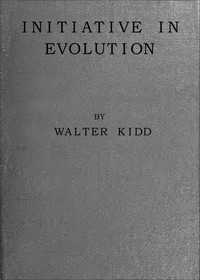
Initiative in Evolution — Themes and Context

(0 User reviews)   767
In Category - Evolution
Kidd, Walter, 1852- Project Gutenberg 2016 Not confirmed
Evolution; Hair Readers of public-domain and historical texts
Project Gutenberg digital edition en

Edition facts

Words 100,979
Reading time 440 min
Text sections 13

The catalog record for Initiative in Evolution — Themes and Context provides practical reading context through 100,979 words, 7 hr 20 min estimated reading time, and 13 detected text sections.

The text analysis averages about 26.5 words per sentence, while the detected sections provide another way to judge how the source is divided.

Project Gutenberg metadata also associates the work with “Evolution,” connecting these edition facts with the source record’s subject description.

Walter Kidd's 1920 work argues for Lamarckian inheritance, using detailed observations of skin, hair, and friction ridges to challenge Weismannism, with a courtroom metaphor framing the debate.
Share
Editorial Edition Score 4.9/5

Calculated from edition completeness, EPUB availability, text structure and catalogue metadata. Not a user rating.

How this score is calculated
  • Description quality20 pts
  • Title & short description10 pts
  • Source metadata20 pts
  • Text length15 pts
  • Chapters / structure15 pts
  • EPUB file integrity20 pts

Total of 100 points, scaled to a 2.5-5.0 range. Editions with an empty description or a missing EPUB file are not scored.

Edition quality

Public-domain source text

Read the source text

The source text is kept in the dedicated reader, separate from this catalogue record and its commentary.

Walter Kidd opens Initiative in Evolution with a courtroom metaphor: the Great War imposed a moratorium on the Lamarck versus Weismann case, now due to be heard afresh. He positions himself as a junior counsel pleading for Lamarck, questioning even Attorneys-General and Lords Chief Justice. This framing sets the tone for a work that is both scientifically detailed and rhetorically combative.

Kidd's evidence centers on mammalian skin—palms, soles, and hair patterns—arguing that friction and pressure over generations shape these structures. He draws on his own studies and those of Wilder Harris and Inez Whipple, whom he enlists as allies for the Lamarckian cause. The excerpts show a writer who blends anatomical precision with a pugnacious defense of use-inheritance.

A Legal Metaphor for Scientific Debate

Kidd’s preface frames the entire book as a legal proceeding. He writes that the war imposed a moratorium, leaving causes over to the next term, and that the Lamarck versus Weismann case is now due to be heard afresh. He calls his chapters “pleadings on behalf of the plaintiff” and himself a “junior counsel.” This is not mere ornament: it structures the argument as a case to be won, with evidence and cross-examination. Kidd warns against retreating into a stronghold, citing Milner’s The End of Controversy as a book that should have been subtitled The End of Progress. He aligns himself with Newtons, Pasteurs, and Darwins, who seldom wielded controversy, while acknowledging his own Gibeonite role—a necessary but lesser helper. The metaphor recurs throughout, giving the scientific exposition a forensic edge.

Friction Skin as Evidence for Use-Inheritance

Kidd devotes careful attention to the skin of palms and soles, which he calls “friction skin,” a term borrowed from Wilder Harris and Inez Whipple. He notes that these regions lack hair and sebaceous glands but contain up to 320 sweat glands per square centimeter, plus papillary ridges. For Kidd, this specialization is a product of repeated pressure and friction over evolutionary time. He argues that the dorsal and extensor surfaces of the body receive more stimuli from lying and sitting than the ventral and flexor surfaces, leading to thicker epidermis on the former and thinner skin on the latter. He asks pointedly whether these differences are “adapted for” or “adapted by” experience, coming down firmly on the side of use-inheritance. He even dismisses survival value, calling the results “indifferent modifications” that merely did not cause the animal to be sieved out.

Hair Patterns and the Lamarckian Mechanism

Kidd’s earlier work on hair direction informs this book. He sees hair patterns as another product of habitual friction and pressure. In the excerpts, he mentions that man’s hairless palms and soles are exceptions, while most mammals lack hair on their pads. He connects this to the “total experience” of stimulus and response over vast stretches of time. Kidd is careful to note that many individuals were exposed to similar stimuli at each stage, implying a cumulative effect across generations. He does not claim that these changes conferred survival advantage or better matrimonial prospects; instead, he treats them as neutral modifications that nonetheless demonstrate the power of use. This argumentative strategy—downplaying adaptation while emphasizing causation—is central to his case against Darwinian natural selection.

The Rhetoric of the Old Contemptibles

Kidd enlists Wilder Harris and Inez Whipple as “allies for us ‘Old Contemptibles’ in the struggle, Lamarck v. Darwin.” This phrase, borrowed from the British Expeditionary Force of 1914, casts the Lamarckians as a beleaguered but tenacious minority. Kidd’s tone is genial but combative: he thanks his allies while implying that mainstream Darwinians are entrenched authorities who need questioning. He writes with urbanity, but his metaphors—courtrooms, sieves, strongholds—reveal a deep commitment to overturning the Weismannian orthodoxy. The excerpts show a writer who is both a meticulous observer of anatomical detail and a polemicist unafraid to name his opponents. This blend of science and advocacy gives the book its distinctive character.

Readers should approach Initiative in Evolution as a period piece in the history of biology, one that argues passionately for a view that was already losing ground. Kidd’s strength lies in his concrete observations of skin and hair, not in theoretical innovation. His courtroom rhetoric can be distracting, but it also clarifies the stakes. For those interested in the Lamarckian tradition or the history of evolutionary thought, this book offers a vivid example of how evidence was marshaled for a losing cause.

Kidd’s courtroom metaphor stayed with me long after closing the book—that quiet urgency of evidence pleading its case. It reminded me of how A first book in organic evolution — Reading Companion once sat with me, its gentler framing of change feeling less like a verdict and more like a slow, patient tide. Some books leave that hushed afterglow.

There are no reviews for this eBook.

0
0 out of 5 (0 User reviews )

Add a Review

Your Rating *
There are no comments for this eBook.

Reader reflection

Your personal reading reflection

Build a private reading journal entry for this title.

Your progress 0 / 10
1

How far have you progressed with this book?

2

Did this book hold your interest?

3

Would you recommend this book to another reader?

4

How demanding did the text feel?

Related eBooks