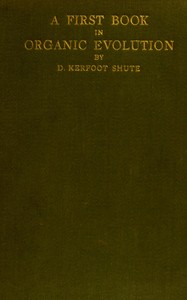
A first book in organic evolution — Reading Companion

(0 User reviews)   674
In Category - Evolution
Shute, D. Kerfoot (Daniel Kerfoot), 1858-1935 Project Gutenberg 2024 Not confirmed
Evolution Readers of public-domain and historical texts
Project Gutenberg digital edition en

Edition facts

Words 72,615
Reading time 316 min
Text sections 22

A first book in organic evolution — Reading Companion can be approached with a clearer sense of reading commitment from its source measurements: 72,615 words, 5 hr 16 min estimated reading time, and 22 detected text sections.

The text analysis averages about 15.8 words per sentence, while the detected sections provide another way to judge how the source is divided.

Project Gutenberg metadata also associates the work with “Evolution,” connecting these edition facts with the source record’s subject description.

An 1899 introductory textbook on evolution, written for medical students and general readers. The excerpts show a focus on animal coloration and sexual selection, using specific examples like rabbits, springboks, and birds of paradise. The author assumes the theory's truth and aims to present it accessibly.
Share
Editorial Edition Score 4.9/5

Calculated from edition completeness, EPUB availability, text structure and catalogue metadata. Not a user rating.

How this score is calculated
  • Description quality20 pts
  • Title & short description10 pts
  • Source metadata20 pts
  • Text length15 pts
  • Chapters / structure15 pts
  • EPUB file integrity20 pts

Total of 100 points, scaled to a 2.5-5.0 range. Editions with an empty description or a missing EPUB file are not scored.

Edition quality

Public-domain source text

Read the source text

The source text is kept in the dedicated reader, separate from this catalogue record and its commentary.

D. Kerfoot Shute’s 1899 textbook opens with a striking plate of a Rock Pigeon transformed into a Pouter, illustrating “the plasticity of a living organism.” The preface declares the book is for medical students at Columbian University and for general readers, assuming evolution’s truth rather than arguing it. The excerpts focus heavily on animal coloration—protective, warning, and sexual—with detailed descriptions of rabbits’ white tails, springboks’ stripes, and the brilliant plumage of male birds of paradise. Shute draws on comparative anatomy and embryology, but the surviving text emphasizes visual examples over theoretical debate.

Coloration as Adaptation and Signal

The excerpts devote considerable space to how animal coloration serves survival and communication. Shute describes rabbits’ white upturned tails as “signals and guides to the feeble and young,” helping the group flee to safety. The springbok’s white stripe above the tail, normally hidden by a skin fold, becomes visible in motion, similarly guiding companions. These examples treat coloration not as static camouflage but as dynamic social signals. Shute also notes exceptions: the musk-sheep, though Arctic-dwelling, is brown and conspicuous because its safety depends on herd cohesion rather than concealment. He calls this “an exception to the rule of local color adaptation that proves the rule.” The reasoning is functional: gregarious animals prioritize mutual recognition over protective coloring.

Sexual Selection and the Divergence of Plumage

Shute presents sexual selection as a key factor in bird coloration, especially among tropical species. He contrasts the “gorgeously colored” male birds of paradise, with their “remarkable gorgets, plumes, and crests,” against the dull, thrush-like females. The same pattern appears in pheasants, chatterers, and tanagers: males display intense crimsons, whites, purples, and blues, while females wear browns or olive greens. Shute explains this divergence through two mechanisms. First, natural selection eliminates conspicuous females during brooding, as hawks detect bright colors. Second, sexual selection drives male ornamentation through rivalry for mates. He describes courtship as “one of the fine arts,” with males displaying their adornments to attract females. The plate of Paradisea minor visually reinforces the argument.

The Author’s Pedagogical Strategy

Shute’s preface reveals a deliberate pedagogical approach: he claims no originality except “in the manner of presenting the subject.” He compiles facts from other observers, sometimes quoting exact language, and arranges them for beginners. The book assumes evolution’s truth rather than proving it, directing readers to comparative anatomy, embryology, physiology, and psychology for supporting arguments. The excerpts show a preference for vivid, concrete examples—rabbit tails, springbok stripes, bird plumage—over abstract theory. Shute addresses his audience directly, aiming to make the doctrine “easily intelligible to the general reader.” The tone is confident and explanatory, treating evolution as an established framework that “enters so largely into all those departments of knowledge that especially concern the human race.”

Readers should note that the excerpts represent only a portion of the book’s content, likely from later chapters on adaptation and selection. The preface indicates broader coverage of comparative anatomy and embryology, which are not sampled here. Shute’s medical background may influence his anatomical focus, but the surviving text emphasizes natural history observations. The book is best approached as a late-19th-century synthesis aimed at non-specialists, reflecting the era’s confidence in evolutionary theory as a unifying principle.

Leafing through A First Book in Organic Evolution, I kept pausing on its careful descriptions of springbok colors, how ordinary these lessons felt for 1899. It made me think of the quieter, stranger volume on my shelf, A Mechanico-Physiological Theory of Organic Evolution — Reading Notes. Both share that same patient wonder at why living things look the way they do.

There are no reviews for this eBook.

0
0 out of 5 (0 User reviews )

Add a Review

Your Rating *
There are no comments for this eBook.

Reader reflection

What did you think of this book?

Answer a few questions and save a private reflection on this device.

Your progress 0 / 10
1

What is your current status with this title?

2

Was reading this book enjoyable?

3

How likely are you to recommend this book?

4

What was the reading difficulty like?

Related eBooks