Elements of Physiophilosophy — Reading Companion

(0 User reviews)   124
In Category - Natural History
Oken, Lorenz, 1779-1851, Tulk, Alfred, -1891 [Translator] Project Gutenberg 2015 Not confirmed
Natural history Readers of public-domain and historical texts
Project Gutenberg digital edition en

Edition facts

Words 213,008
Reading time 927 min
Text sections 34

Before opening Elements of Physiophilosophy — Reading Companion, the edition data offers a quick orientation: 213,008 words, 15 hr 27 min estimated reading time, and 34 detected text sections.

The text analysis averages about 19.1 words per sentence, while the detected sections provide another way to judge how the source is divided.

Project Gutenberg metadata also associates the work with “Natural history,” connecting these edition facts with the source record’s subject description.

This editorial note examines how Lorenz Oken's 'Elements of Physiophilosophy' uses numbered propositions and cosmic analogies to build a system where plants and animals are defined by their relation to light, darkness, and planetary forces.
Share
Editorial Edition Score 4.9/5

Calculated from edition completeness, EPUB availability, text structure and catalogue metadata. Not a user rating.

How this score is calculated
  • Description quality20 pts
  • Title & short description10 pts
  • Source metadata20 pts
  • Text length15 pts
  • Chapters / structure15 pts
  • EPUB file integrity20 pts

Total of 100 points, scaled to a 2.5-5.0 range. Editions with an empty description or a missing EPUB file are not scored.

Edition quality

Public-domain source text

Read the source text

The source text is kept in the dedicated reader, separate from this catalogue record and its commentary.

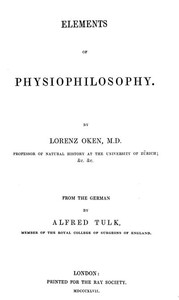
Lorenz Oken's Elements of Physiophilosophy opens with a translator's preface that immediately signals the work's ambition: it was begun 'without the cognizance, or at the suggestion of a single human being,' driven by the original's 'kindred spirit.' The translator, Alfred Tulk, positions himself not as a disciple but as a 'labourer at second-hand,' wary of sectarian praise. This self-awareness sets the stage for a text that proceeds not by narrative but by numbered propositions—a structure that invites readers to treat each statement as a building block in a grand, speculative system.

Numbered Propositions as a Reading Method

The text is organized into over 3,600 numbered paragraphs, each a concise assertion. For example, paragraph 1774 states: 'An animal is a floral vesicle freely separated from the earth, and living alone through its own motion in the water and air.' This format demands that readers engage with each claim as a discrete unit, yet the cumulative effect is a web of interconnected ideas. Oken often revisits and refines concepts across multiple entries, so a first-time reader should note the numbers: they are not arbitrary but trace the logical progression of his argument. The numbering also allows for cross-references, though the excerpts do not reveal whether Oken explicitly links them. Pay attention to how a single paragraph (e.g., 1775) can pivot from a general principle—'Every Organic originates from a mucus-point'—to a specific classification of plants and animals based on light and darkness.

Light, Darkness, and the Reversal of Worlds

A central, recurring contrast in the excerpts is between light and darkness as cosmic forces that determine organic form. Oken writes that a plant is a 'darkness-mucus-vesicle' that 'works its way unto air and light,' while an animal is a 'light-mucus-vesicle' that contains all elements within itself. This opposition is not merely metaphorical; it is structural. In paragraph 1773, he claims that 'the relations to the world are completely reversed' in plants and animals: the plant is immersed in earth, water, and air, whereas these elements are 'immersed in the animal.' For a reader, this inversion is a key to understanding Oken's system: he consistently defines entities by their cosmic position rather than by observable traits alone. The animal is likened to a 'whole solar system' or 'microcosm,' while the plant is merely a 'planet' or 'microplanet.' These analogies are not decorative but foundational to his argument.

The Role of Water and the Littoral Origin of Life

Oken grounds his speculative biology in specific claims about the origin of animals. Paragraph 1781 asserts: 'Water is the origin or source of all animals.' He elaborates that animals 'originated upon the sea-shore, but not in the midst of the sea, nor in that of the land.' This littoral hypothesis is accompanied by a striking image: 'The deluge cast up the first men.' Oken then speculates that early humans were 'carnivorous, as savages still are,' because fruits and vegetables would not have been available. These statements are presented as logical deductions from his system, not as empirical findings. A reader should note how Oken moves from abstract principles (light vs. darkness) to concrete, even provocative, historical claims. The excerpts do not reveal whether he provides evidence for these assertions, but the tone is confident and declarative. This section of the text shows how physiophilosophy blends cosmology, biology, and anthropology into a single narrative.

Sensation and Motion as Cosmic Relations

In paragraphs 1783–1786, Oken defines sensation and motion not as biological functions but as expressions of cosmic polarity. Sensation is 'the relation of the Central to the Peripheric, of the sun to the planet'; motion is 'the relation of th' (the excerpt cuts off). Even incomplete, this passage reveals Oken's method: he borrows astronomical terms—'polarization,' 'æther-polarity,' 'central polarity'—to explain animal perception. The animal, like the sun, has 'the principle of its polarization or determination in itself.' This is a radical departure from mechanistic or empirical accounts of sensation. For a first-time reader, the challenge is to follow how Oken maps physical concepts onto biological ones without reducing either. The text demands that you hold two frames simultaneously: the literal (an animal moves) and the analogical (that movement mirrors solar dynamics). The excerpts do not clarify how Oken resolves this tension, but they show that his system is built on such parallels.

Reading Elements of Physiophilosophy requires patience with its numbered, propositional style and willingness to treat cosmic analogies as serious arguments. The excerpts suggest that Oken's system is internally consistent but not empirically tested; his claims about light, water, and the littoral origin of life are best approached as philosophical axioms rather than hypotheses. A first reader may benefit from tracking how each numbered paragraph contributes to a larger pattern—especially the recurring reversals between plant and animal, darkness and light, planet and solar system. The translator's preface hints at the work's ambition to instruct, and the text delivers that instruction in a form that rewards careful, sequential attention.

Reading Oken’s numbered cosmos, I recalled my grandfather’s shelf, how he’d trace the same light through leaf and stone. Elements feels like that patient ordering of chaos. But then I remembered the earthy sprawl of Buffon's Natural History. Volume 07 (of 10) Containing a Theory of the Earth, a General History of Man, of the Brute Creation, and of Vegetables, Minerals, &c. &c — Context and Discussion, where the world refuses neat propositions, preferring slow, muddy becoming. Both offered the same humbling warmth.

There are no reviews for this eBook.

0
0 out of 5 (0 User reviews )

Add a Review

Your Rating *
There are no comments for this eBook.

Reader reflection

Your personal reading reflection

Build a private reading journal entry for this title.

Your progress 0 / 10
1

How far have you progressed with this book?

2

How much did you enjoy the reading experience?

3

Would you pass this book on to a friend?

4

How much effort did this book require?

Related eBooks