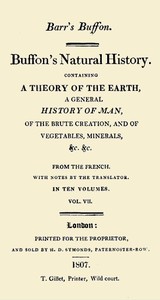
Buffon's Natural History. Volume 07 (of 10) Containing a Theory of the Earth, a General History of Man, of the Brute Creation, and of Vegetables, Minerals, &c. &c — Context and Discussion
Edition facts
Buffon's Natural History. Volume 07 (of 10) Containing a Theory of the Earth, a General History of Man, of the Brute Creation, and of Vegetables, Minerals, &c. &c — Context and Discussion can be approached with a clearer sense of reading commitment from its source measurements: 76,876 words, 5 hr 35 min estimated reading time, and 10 detected text sections.
The text analysis averages about 35.4 words per sentence, while the detected sections provide another way to judge how the source is divided.
Project Gutenberg metadata also associates the work with “Natural history,” connecting these edition facts with the source record’s subject description.
Calculated from edition completeness, EPUB availability, text structure and catalogue metadata. Not a user rating.
How this score is calculated
- Description quality20 pts
- Title & short description10 pts
- Source metadata20 pts
- Text length15 pts
- Chapters / structure15 pts
- EPUB file integrity20 pts
Total of 100 points, scaled to a 2.5-5.0 range. Editions with an empty description or a missing EPUB file are not scored.
Public-domain source text
Read the source text
The source text is kept in the dedicated reader, separate from this catalogue record and its commentary.
Buffon opens Volume VII by confronting the confusion surrounding the term "tiger." He notes that travellers have conflated leopards, panthers, ounces, and lynxes under that name, and he insists that only one animal truly deserves the title. This taxonomic clarification sets the tone for the volume: Buffon is as concerned with correcting misnomers as with describing animals. His method is comparative and historical, drawing on Aristotle, Pliny, and modern travellers while asserting his own authority to distinguish species. The reader is immediately placed in a world where naming is contested and where observation must cut through inherited error.
The Opening Strategy: Naming and Authority
The first pages of the volume establish a pattern that recurs throughout. Buffon begins by declaring the word "tiger" a generic name given to several species, then proceeds to disentangle them. He cites Pliny's description of the tiger as an animal of tremendæ velocitatis but notes that the ancients knew little of the real tiger. This move—acknowledging earlier authorities while pointing out their limitations—is typical of Buffon's approach. He does not reject tradition outright but uses it as a springboard for his own classification. The reader should watch for this pattern in later entries: Buffon often starts with a terminological problem, then supplies his own distinctions based on geography, size, and behaviour.
Comparative Geography and Species Distinction
In the section on squirrels, Buffon employs a comparative method that spans continents. He notes that the grey squirrel of America, the blackish squirrel of Fernandes, and the grey squirrel of Europe may be the same species, but he refuses to affirm it without more evidence. Similarly, he compares the palmist, the squirrel of Barbary, and the squirrel of Switzerland, listing differences in stripe patterns, tail carriage, and habitat. The palmist has three white stripes and carries its tail erect; the Swiss squirrel has four stripes and brings its tail down on its back. Buffon concludes they are different species, partly because they inhabit different climates. This geographic reasoning is a hallmark of the volume and rewards careful attention.
The Role of Anecdotal Evidence
Buffon occasionally includes striking anecdotes that seem to come from travellers or naturalists. One such passage describes squirrels in Lapland using their tails as sails on makeshift rafts, forming fleets of three or four thousand. If the wind is too strong, a general shipwreck ensues, to the profit of Laplanders who find the bodies. Buffon attributes this to the Oeuvres de M. Regnard. Such stories sit uneasily alongside his careful taxonomic work. They remind the reader that Buffon's natural history is a composite of firsthand observation, classical learning, and travellers' tales. The reader should note when Buffon cites a source and when he offers his own judgment, as the balance shifts between scepticism and wonder.
The Translator's Presence
The title page announces that this edition includes notes by the translator, James Smith Barr. While the excerpts do not show Barr's annotations, the reader should be aware that the English text is a mediated version of Buffon's French original. Barr's editorial role is signalled by the phrase "Barr's Buffon" on the contents page. The volume also contains directions for placing plates, indicating that the illustrations were integral to the work. When reading, consider how the translator's choices—in vocabulary, in the selection of notes, in the presentation of the text—shape the experience. The Project Gutenberg edition preserves the typography and layout of the 1807 printing, including the long 's' and the original pagination, which adds a historical texture to the reading.
As you read Volume VII, attend to the interplay between Buffon's systematic ambitions and the messy particulars of his sources. He is building a natural history that is both encyclopedic and argumentative, and each entry rewards attention to his method of comparison, his use of authorities, and his moments of hesitation. The volume is best approached not as a reference work but as a developing argument about how to classify the natural world.
The rain kept me indoors with Volume VII, tracing Buffon’s patient lines between the wolf and the fox, until my eyes wandered to the shelf. Beside it sat a slimmer, older spine. I pulled down Elements of Physiophilosophy — Reading Companion without thinking. The same unhurried curiosity, the same quiet trust in naming things, met me there. One book simply handed me to the next, like a long, easy sigh.
There are no reviews for this eBook.
Record your reading impressions
A brief reflection can help important ideas stay with you longer.