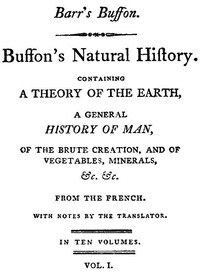
Buffon's Natural History, Volume 01 (of 10) Containing a Theory of the Earth, a General History of Man, of the Brute Creation, and of Vegetables, Mineral, &c. &c — Edition Insights

(0 User reviews)   224
In Category - Natural History
Buffon, Georges Louis Leclerc, comte de, 1707-1788, Barr, James Smith [Editor] Project Gutenberg 2014 Not confirmed
Natural history Readers of public-domain and historical texts
Project Gutenberg digital edition en

Edition facts

Words 72,762
Reading time 317 min
Text sections 7

Buffon's Natural History, Volume 01 (of 10) Containing a Theory of the Earth, a General History of Man, of the Brute Creation, and of Vegetables, Mineral, &c. &c — Edition Insights can be approached with a clearer sense of reading commitment from its source measurements: 72,762 words, 5 hr 17 min estimated reading time, and 7 detected text sections.

The text analysis averages about 41.8 words per sentence, while the detected sections provide another way to judge how the source is divided.

Project Gutenberg metadata also associates the work with “Natural history,” connecting these edition facts with the source record’s subject description.

This editorial note examines the authorial choices in Buffon's Natural History, Volume 01, focusing on his rhetorical strategies, use of evidence, and stylistic blend of empirical observation and speculative reasoning in the Theory of the Earth and related articles.
Share
Editorial Edition Score 4.7/5

Calculated from edition completeness, EPUB availability, text structure and catalogue metadata. Not a user rating.

How this score is calculated
  • Description quality20 pts
  • Title & short description10 pts
  • Source metadata20 pts
  • Text length15 pts
  • Chapters / structure15 pts
  • EPUB file integrity20 pts

Total of 100 points, scaled to a 2.5-5.0 range. Editions with an empty description or a missing EPUB file are not scored.

Edition quality

Public-domain source text

Read the source text

The source text is kept in the dedicated reader, separate from this catalogue record and its commentary.

Buffon opens his Natural History with a confident assertion that the study of nature is “the source of universal instruction and knowledge,” a claim that sets the tone for a work that is as much a philosophical treatise as a scientific catalogue. The preface immediately distinguishes Buffon from his contemporaries: where Ray, Linnaeus, and Réaumur are credited with classification, Buffon alone is said to have “entered into a description of their nature, habits, uses, and properties.” This editorial note focuses on the authorial choices visible in Buffon’s diction, dialogue, and description—specifically his rhetorical framing, his handling of evidence, and his stylistic blend of empirical observation with speculative reasoning.

Rhetorical Framing and the Role of the Preface

The preface functions as a deliberate positioning of Buffon’s work within the intellectual currents of the late eighteenth century. The editor, James Smith Barr, writes that Buffon “has displayed a wonderful ingenuity, and shewn the general order of Nature with a masterly hand,” while also noting a potential objection: Buffon “prefer[s] physical reasonings on general causes, rather than allowing aught to have arisen from supernatural agency.” This framing is not neutral; it alerts the reader to a tension between natural philosophy and theology that runs throughout the volume. The preface also establishes Buffon as a singular figure—one who “stands eminently distinguished” among natural philosophers—and thereby primes the reader to expect a work of both breadth and originality. The diction is formal and laudatory, yet the editor’s caveat about “supernatural agency” introduces a note of caution that colors how the subsequent arguments are to be received.

Use of Historical Evidence and Authorial Voice

In the section on ancient navigation, Buffon engages with historical testimonies from Herodotus, Pliny, Cornelius Nepos, and others to argue that the ancients did not double the Cape of Good Hope. His method is to cite sources, then weigh their credibility. For instance, he dismisses claims of an ancient circumnavigation by noting that “the Portuguese took the first to go to the East-Indies, was looked upon as a new discovery.” The passage includes a lengthy quotation from an Arabic source describing a shipwreck that supposedly proved a sea route from China to the Mediterranean. Buffon’s voice emerges in his skeptical commentary: “The ignorance of those ages… will appear perhaps less singular than the silence of the editor.” This interplay between quotation and critical assessment reveals an author who values empirical evidence but is also willing to engage with speculative possibilities. The diction shifts between authoritative assertion and cautious inference, reflecting the tension between Buffon’s ambition to explain natural phenomena and the limitations of the available data.

Stylistic Blend of Observation and Speculation

Buffon’s prose in the Theory of the Earth articles combines detailed geographical description with broad theoretical claims. In Article VI on Geography, he moves from specific observations—such as the distribution of shells in inland strata—to general principles about the formation of the earth. The style is characterized by long, periodic sentences that accumulate evidence before arriving at a conclusion. For example, he writes of the “Proof of the Theory of the Earth” as a series of articles that systematically build an argument. The language is often vivid: “the sea surrounds China and Cila, the extremity of Turqueston and the country of the Cozars.” Yet Buffon also acknowledges uncertainty, as when he notes that “we are persuaded that they never doubled the Cape of Good Hope” despite ancient testimonies. This blend of confidence and qualification gives the text a distinctive intellectual honesty, even as it pushes the boundaries of contemporary knowledge.

Dialogue with Other Naturalists and the Editor’s Role

The volume includes extensive references to other naturalists—Whiston, Burnet, Woodward—whose systems Buffon critiques. In Articles II through V, he systematically examines their theories, pointing out inconsistencies and offering his own alternatives. The editor, James Smith Barr, adds footnotes and commentary that sometimes clarify or challenge Buffon’s claims. For instance, the preface notes that Buffon “may be subject to some objections for preferring physical reasonings on general causes.” This editorial presence creates a layered text: Buffon’s original French arguments are filtered through an English translation and supplemented by Barr’s annotations. The result is a dialogue across time and language, where the reader encounters not only Buffon’s voice but also the interpretive lens of his editor. The diction remains formal throughout, but the interplay of voices adds a dynamic quality to the exposition.

Readers approaching this volume should attend to the interplay between Buffon’s confident assertions and his cautious qualifications. The text rewards careful attention to how evidence is marshaled and how the author positions himself relative to his predecessors. The editor’s notes provide a useful counterpoint, often highlighting the philosophical assumptions underlying Buffon’s arguments. This is not a work of pure observation but one of reasoned speculation, and its value lies as much in its rhetorical strategies as in its factual content.

There’s something comforting in how Buffon’s old theories let the mind wander, even when the science has moved on. I felt that same quiet pleasure reading Outlines of Creation — Inside the Classic, as if both books share a patient, wondering tone. It’s not about accuracy now, but about the charm of earnest speculation.

There are no reviews for this eBook.

0
0 out of 5 (0 User reviews )

Add a Review

Your Rating *
There are no comments for this eBook.

Reader reflection

Record your reading impressions

A brief reflection can help important ideas stay with you longer.

Your progress 0 / 10
1

Which reading stage best describes you?

2

What was your overall reaction to the book?

3

How likely are you to recommend this book?

4

How demanding did the text feel?

Related eBooks