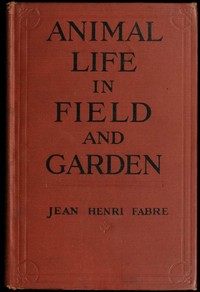
Animal Life in Field and Garden — A Closer Reading

(0 User reviews)   357
In Category - Natural History
Fabre, Jean-Henri, 1823-1915, Bicknell, Florence Constable, 1858-1941 [Translator] Project Gutenberg 2021 Not confirmed
Natural history -- Juvenile literature Readers of public-domain and historical texts
Project Gutenberg digital edition en

Edition facts

Words 97,272
Reading time 423 min
Text sections 56

The catalog record for Animal Life in Field and Garden — A Closer Reading provides practical reading context through 97,272 words, 7 hr 3 min estimated reading time, and 56 detected text sections.

The text analysis averages about 22.1 words per sentence, while the detected sections provide another way to judge how the source is divided.

Project Gutenberg metadata also associates the work with “Natural history -- Juvenile literature,” connecting these edition facts with the source record’s subject description.

Fabre's natural history book, structured as Uncle Paul's evening talks, uses a friend-or-foe framework to examine garden and field animals. The translation by Florence Constable Bicknell preserves the conversational tone and detailed observations of animal behavior, from bats to shrikes.
Share
Editorial Edition Score 4.9/5

Calculated from edition completeness, EPUB availability, text structure and catalogue metadata. Not a user rating.

How this score is calculated
  • Description quality20 pts
  • Title & short description10 pts
  • Source metadata20 pts
  • Text length15 pts
  • Chapters / structure15 pts
  • EPUB file integrity20 pts

Total of 100 points, scaled to a 2.5-5.0 range. Editions with an empty description or a missing EPUB file are not scored.

Edition quality

Public-domain source text

Read the source text

The source text is kept in the dedicated reader, separate from this catalogue record and its commentary.

Jean-Henri Fabre's Animal Life in Field and Garden opens not with a formal lecture but with Uncle Paul sitting under an elder tree one evening in May, addressing his nephews. This framing device establishes the book as a series of spoken talks, a structure that shapes the entire work. The conversational tone is evident from the first chapter, where Uncle Paul proposes to designate animals as 'friends' or 'foes' based on their agricultural impact. This binary framework—though later complicated by creatures like the cuckoo, which destroys caterpillars but also evicts warbler chicks—provides a consistent organizing principle across the book's 56 chapters.

The Friend-or-Foe Framework

Uncle Paul's initial classification is deceptively simple: 'friends' are animals that aid farmers by controlling pests, while 'foes' are the pests themselves. However, as the chapters progress, this dichotomy blurs. For instance, the cuckoo is praised for devouring hairy caterpillars but condemned for throwing warbler nestlings out of their nests. Fabre, through Uncle Paul, acknowledges this complexity, calling such birds 'doubtful helpers.' The shrike, too, is described as a 'great insect-destroyer' yet also a 'barbarous slaughterer of small birds.' This nuanced treatment suggests that the friend-or-foe lens is less a rigid taxonomy and more a starting point for exploring the moral and ecological ambiguities of animal behavior.

Movement Between Scenes

The book's structure mirrors the movement of its subjects: from the garden elder tree to the bat's wing, from the mole's underground nest to the owl's nocturnal flight. Each chapter shifts to a new creature or habitat, creating a sense of continuous motion. For example, the bat chapter examines its wings and senses, while the hedgehog chapter discusses hibernation. This progression is not arbitrary; it follows a logical sequence from mammals to birds to insects, but within that sequence, Fabre often juxtaposes creatures by their ecological roles. The movement between scenes keeps the reader engaged, as each chapter offers a fresh setting and a new set of behaviors to observe.

Recurring Images and Details

Fabre's descriptions are rich with recurring images that anchor the reader's attention. The bat's wing is described in detail, as is the shrike's hooked beak and talons. These physical details are not mere ornament; they serve to illustrate the creature's way of life. For instance, the shrike's 'strong hooked beak, toothed toward the tip' and 'powerful talons ending in sharp nails' are directly linked to its predatory habits. Similarly, the cuckoo's behavior is illustrated through the vivid image of it 'brutally throwing out of their nest the little birds.' Such recurring focus on anatomy and action reinforces the book's central theme: that form follows function in the natural world.

The Translator's Role

Florence Constable Bicknell's translation preserves the conversational rhythm of Fabre's original French. The text reads as if Uncle Paul is speaking directly to the reader, with phrases like 'Let us get on' and 'You have just seen' maintaining the illusion of a live talk. Bicknell also retains Fabre's precise observations, such as the shrike's cry of 'truee, truee' and the description of its eggs with a 'ring of brown spots' at the large end. This fidelity to detail ensures that the English version conveys the same sense of wonder and scientific curiosity that characterizes Fabre's work.

Readers approaching Animal Life in Field and Garden should attend to the interplay between Uncle Paul's conversational frame and the detailed natural history that follows. The book rewards those who read it as a series of connected talks rather than a dry encyclopedia. Pay attention to how Fabre uses physical descriptions to reveal behavior, and note the moments when the friend-or-foe classification breaks down—these are where the most interesting insights lie.

That afternoon, the rain pattered against the window as I lost myself in Uncle Paul’s quiet talks, watching a shrike’s patient cruelty described with such gentle precision. I closed the book thinking about how we impose our own moral order on the garden’s business. Later, idly tracing that thought about creatures and their natures, my hand fell to Buffon's Natural History, Volume 01 (of 10) Containing a Theory of the Earth, a General History of Man, of the Brute Creation, and of Vegetables, Mineral, &c. &c — Edition Insights, where the Earth’s own slow story seemed to answer, quietly, the same questions.

There are no reviews for this eBook.

0
0 out of 5 (0 User reviews )

Add a Review

Your Rating *
There are no comments for this eBook.

Reader reflection

What did you think of this book?

Answer a few questions and save a private reflection on this device.

Your progress 0 / 10
1

How far have you progressed with this book?

2

How much did you enjoy the reading experience?

3

Would you pass this book on to a friend?

4

How easy was the book to follow?

Related eBooks