
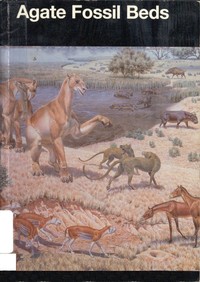
Agate Fossil Beds National Monument, Nebraska — Inside the Classic
Edition facts
Before opening Agate Fossil Beds National Monument, Nebraska — Inside the Classic, the edition data offers a quick orientation: 24,993 words, 1 hr 49 min estimated reading time, and 5 detected text sections.
The text analysis averages about 19.3 words per sentence, while the detected sections provide another way to judge how the source is divided.
Project Gutenberg metadata also associates the work with “Paleontology -- Miocene,” connecting these edition facts with the source record’s subject description.
Calculated from edition completeness, EPUB availability, text structure and catalogue metadata. Not a user rating.
How this score is calculated
- Description quality20 pts
- Title & short description10 pts
- Source metadata20 pts
- Text length15 pts
- Chapters / structure15 pts
- EPUB file integrity20 pts
Total of 100 points, scaled to a 2.5-5.0 range. Editions with an empty description or a missing EPUB file are not scored.
Public-domain source text
Read the source text
The source text is kept in the dedicated reader, separate from this catalogue record and its commentary.
The handbook opens by inviting readers to imagine a young hunter in post-Civil War Michigan, drawn westward by stories of the frontier. This narrative device frames the discovery of the fossil beds not as a dry scientific account but as a human story of exploration. The text then shifts to a detailed examination of Miocene ecosystems, describing how the uplift of the Rocky Mountains transformed a tree-dotted savanna into grasslands, a change recorded in the fossil bones of grazing horses like Merychippus. The handbook consistently ties geological events to the fossil evidence, emphasizing that the area's significance lies in its vertebrate record, while noting that plant fossils are almost entirely absent due to groundwater chemistry that preserved bone but destroyed flora.
A Landscape Built by Uplift and Erosion
The handbook explains that the fossil beds are the product of repeated cycles of stream deposition and erosion, driven by the uplift of the Rocky Mountains. As the mountains rose, the climate became more arid, and the ancient savanna gave way to grasslands. This environmental shift is documented in the Sheep Creek Formation, where the appearance of the grazing horse Merychippus marks the establishment of grasslands as the dominant ecosystem. The text describes how later uplift events caused further erosion, washing away earlier deposits, and how the Snake Creek Beds were laid down during the Late Miocene and Pliocene. Notably, the handbook states that after Snake Creek times, the Agate area was "left out of the mainstream of events," with no further deposition recorded. This precise geological timeline is a key feature of the work, grounding the fossil finds in a dynamic landscape history.
Fossils Without Plants: The Limits of the Record
One of the handbook's most striking observations is the near-total absence of plant fossils in the Agate area. It notes that while the Oligocene sediments of the region contain "one of the best vertebrate fossil records in the world," the plant record is "almost non-existent." The reason given is that groundwater chemistry that preserved bones was "hostile to the preservation of plants." Only hackberries (Celtis) and walnuts (Juglans) are recorded from the Oligocene, and the text acknowledges that these "tell us almost nothing about the environment" because they are so widespread. To infer the ancient flora, the handbook projects knowledge from other Rocky Mountain areas, a clear admission of the gaps in the local evidence. This honest treatment of the fossil record's limitations is a notable strength of the work.
From Ranch to National Monument
The handbook includes a brief account of James H. Cook, who examined fossil fragments at the quarries near Agate Springs Ranch around 1918. Cook collected not only fossils but also Indian artifacts, which he kept in his study. The text mentions that his son, Harold Cook, later collaborated with W. D. Matthew of the American Museum of Natural History, publishing important papers on the finds. The handbook notes that "animals new to science are still being discovered in the Snake Creek Beds," indicating ongoing research. However, the excerpts provide no details about the monument's establishment or its current management; the focus remains on the early exploration and the scientific significance of the site. This section grounds the paleontological narrative in a specific human and institutional history.
Readers should note that this handbook is part of the National Park Service's Handbook series (number 107), designed as a compact introduction for visitors. The text assumes no prior knowledge of paleontology or geology, explaining technical concepts like stream deposition and faunal succession in accessible language. The work is structured in three parts: an introduction to the park, a scientific examination of the fossils and geology, and a guide for visitors. The excerpts suggest that the handbook balances scientific rigor with readability, making it a useful resource for anyone interested in the Miocene fossils of the Great Plains.
When the NPS handbook describes those ancient bones resting in Nebraska’s clay, I think of the old encyclopedists who first tried to name such creatures without ever seeing them. I’ve shelved Buffon's Natural History. Volume 04 (of 10) Containing a Theory of the Earth, a General History of Man, of the Brute Creation, and of Vegetables, Minerals, &c. &c — Themes and Context beside that guide for years; both humbly whisper that the earth remembers longer than we do.
There are no reviews for this eBook.
How will you remember this book?
Save your reaction, strongest insight, and memorable passage.