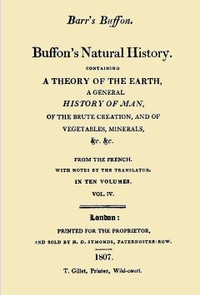
Buffon's Natural History. Volume 04 (of 10) Containing a Theory of the Earth, a General History of Man, of the Brute Creation, and of Vegetables, Minerals, &c. &c — Themes and Context

(0 User reviews)   716
In Category - Natural History
Buffon, Georges Louis Leclerc, comte de, 1707-1788, Barr, James Smith [Editor] Project Gutenberg 2014 Not confirmed
Natural history Readers of public-domain and historical texts
Project Gutenberg digital edition en

Edition facts

Words 73,309
Reading time 319 min
Text sections 8

This digital edition of Buffon's Natural History. Volume 04 (of 10) Containing a Theory of the Earth, a General History of Man, of the Brute Creation, and of Vegetables, Minerals, &c. &c — Themes and Context is described by source-level measurements including 73,309 words, 5 hr 19 min estimated reading time, and 8 detected text sections.

The text analysis averages about 31.0 words per sentence, while the detected sections provide another way to judge how the source is divided.

Project Gutenberg metadata also associates the work with “Natural history,” connecting these edition facts with the source record’s subject description.

This volume of Buffon's Natural History examines human development from infancy through old age, the senses, and racial varieties, blending empirical observation with philosophical reflection. Notable for its vivid first-person narrative of a man born adult, exploring perception and the acquisition of knowledge through touch, sight, and taste.
Share
Editorial Edition Score 4.7/5

Calculated from edition completeness, EPUB availability, text structure and catalogue metadata. Not a user rating.

How this score is calculated
  • Description quality20 pts
  • Title & short description10 pts
  • Source metadata20 pts
  • Text length15 pts
  • Chapters / structure15 pts
  • EPUB file integrity20 pts

Total of 100 points, scaled to a 2.5-5.0 range. Editions with an empty description or a missing EPUB file are not scored.

Edition quality

Public-domain source text

Read the source text

The source text is kept in the dedicated reader, separate from this catalogue record and its commentary.

Buffon's fourth volume opens with a striking departure from straightforward natural history: a first-person account of a man who awakens fully grown, without memory or knowledge of the world. This narrative, embedded within a chapter on the senses, dramatizes the process of sensory discovery. The protagonist learns to distinguish self from external objects by touch, mistakes the sun for a tangible thing, and experiences the taste of fruit as a revelation. The passage is remarkable for its introspective voice and its philosophical inquiry into how we come to know reality. Buffon uses this fictional scenario to illustrate the primacy of touch in correcting visual illusions, a theme that recurs throughout the volume's discussions of perception.

Infancy and the Body in Early Life

The volume begins with practical advice on infant care, grounded in observations of bodily needs. Buffon notes that newborns sleep most of the first month, waking only from pain or hunger, and that their cries are the sole means of signaling distress. He emphasizes the importance of cleanliness, describing how North American indigenous peoples use wood dust in cradles to absorb moisture, and how in Virginia infants are placed naked on a plank with a hole for excrement. These details reveal Buffon's comparative method, drawing on global practices to argue for attentive care. The tone is direct and prescriptive, focusing on the physical vulnerabilities of early life.

The Senses as Gateways to Knowledge

In the chapters on seeing, hearing, and the senses in general, Buffon shifts from bodily care to epistemology. The fictional narrative of the newly created man serves as a thought experiment: he initially believes all objects are equally near, and only through repeated trials does he learn to coordinate eye and hand. The description of eating fruit—its weight, fragrance, and taste—is rendered with sensory vividness, culminating in a feeling of power over external substances. Buffon presents the senses not as passive receptors but as active tools for constructing reality, with touch serving as the ultimate corrective to sight's deceptions.

Old Age, Death, and Human Varieties

The later chapters address the end of life and the range of human forms. Buffon describes old age as a gradual decline, with the senses dulling and the body losing its vigor. His account of death is clinical, focusing on physiological changes rather than metaphysical speculation. The final chapter on varieties in the human species catalogues differences in skin color, stature, and custom, though the excerpts offer only a glimpse of this section. Throughout, Buffon maintains a taxonomic impulse, treating human life as part of a broader natural order, yet his earlier philosophical digressions lend the volume an unexpected introspective depth.

Readers approaching this volume should note its dual character: part practical manual on human development, part philosophical meditation on perception. The extended fictional passage in the senses chapters is a highlight, offering a rare window into Buffon's speculative imagination. Pay attention to how he weaves empirical detail with narrative—the contrast between the dry advice on infant care and the lyrical account of tasting fruit reveals the range of his authorial voice. This volume rewards those who read across its sections, tracing how Buffon's method shifts from observation to introspection and back again.

That Buffon passage about the man born adult—how he has to learn everything through touch, slowly, patiently—stayed with me for days. It made me think of the body as a mystery we’re always decoding, which is exactly the quiet ache I felt in The Story of the Living Machine A Review of the Conclusions of Modern Biology in Regard to the Mechanism Which Controls the Phenomena of Living Activity — Edition Insights. Same wonder, different era.

There are no reviews for this eBook.

0
0 out of 5 (0 User reviews )

Add a Review

Your Rating *
There are no comments for this eBook.

Reader reflection

Before you leave, reflect on the book

Use these questions to collect your thoughts before moving on.

Your progress 0 / 10
1

How far have you progressed with this book?

2

Was reading this book enjoyable?

3

Would you recommend this book to another reader?

4

How much effort did this book require?

Related eBooks