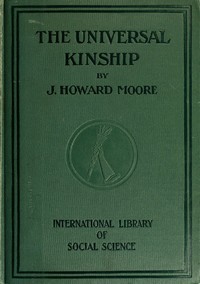
The Universal Kinship — A Closer Reading

(0 User reviews)   73
In Category - Evolution
Moore, J. Howard (John Howard), 1862-1916 Project Gutenberg 2020 Not confirmed
Sociology; Evolution; Human beings Readers of public-domain and historical texts
Project Gutenberg digital edition en

Edition facts

Words 87,246
Reading time 380 min
Text sections 10

For The Universal Kinship — A Closer Reading, the stored edition analysis reports 87,246 words, 6 hr 20 min estimated reading time, and 10 detected text sections.

The text analysis averages about 25.4 words per sentence, while the detected sections provide another way to judge how the source is divided.

Project Gutenberg metadata also associates the work with “Sociology,” connecting these edition facts with the source record’s subject description.

J. Howard Moore argues for the physical, psychical, and ethical kinship of all Earth's inhabitants, challenging human exceptionalism through evolutionary biology and comparative psychology.
Share
Editorial Edition Score 4.8/5

Calculated from edition completeness, EPUB availability, text structure and catalogue metadata. Not a user rating.

How this score is calculated
  • Description quality20 pts
  • Title & short description10 pts
  • Source metadata20 pts
  • Text length15 pts
  • Chapters / structure15 pts
  • EPUB file integrity20 pts

Total of 100 points, scaled to a 2.5-5.0 range. Editions with an empty description or a missing EPUB file are not scored.

Edition quality

Public-domain source text

Read the source text

The source text is kept in the dedicated reader, separate from this catalogue record and its commentary.

J. Howard Moore opens The Universal Kinship with a bold thesis: all inhabitants of the planet—whether they 'swim, fly, crawl, or ambulate'—are related physically, mentally, and morally. Writing in 1906, Moore, a zoology instructor, directly confronts what he calls 'widely-practised and highly-prized sins' of human arrogance. The book is structured in three parts—Physical, Psychical, and Ethical Kinship—each building a case for continuity across species. Moore does not merely catalog similarities; he insists that kinship demands a radical rethinking of ethics, one that extends beyond the human sphere.

From Homology to Genealogy

The first section, 'The Physical Kinship,' traces human anatomy through a descending hierarchy: man as animal, vertebrate, mammal, primate. Moore uses homology—shared bodily structures—as evidence of common descent. He argues that the 'Earth an Evolution' and that the 'Genealogy of Animals' culminates not in human supremacy but in a web of relation. The chapter titles themselves form a syllogism: if man is a primate, and primates are mammals, then the physical link is inescapable. Moore's method is cumulative, piling evidence from comparative anatomy and embryology, though the excerpts offer only the skeleton of his argument.

Memory, Language, and the Parrot's Aria

In the 'Psychical Kinship' section, Moore turns to animal minds. He describes purple martins returning annually to Chicago's Field Columbian Museum, geese anticipating market-day, and a parrot that 'remembered the voice of its mistress after an absence of a year and a half.' Most striking is the Salzburg parrot that 'learned long poems by heart' and sang 'an entire aria from Flotow’s opera of Martha.' Moore uses these anecdotes to argue that mental faculties differ in degree, not kind. He notes that verbal poverty is 'pieced out by verbal variation,' comparing bird calls to Chinese tonal modulation. The evidence is observational, not experimental, and Moore freely admits ignorance—'I wonder what led to the establishing of the custom'—but the cumulative effect challenges the reader to dismiss animal cognition outright.

The Ethics of the Jungle and the Future

The final section, 'Ethical Kinship,' extends the argument to morality. Moore claims that 'Human Nature a Product of the Jungle' and traces ethics from savage codes to modern provincialism. He contrasts 'Egoism and Altruism' and critiques 'Anthropocentric Ethics' as a barrier to universal kinship. The book's preface predicts that 'the time will come when the sentiments of these pages will not be hailed by two or three, and ridiculed or ignored by the rest; they will represent Public Opinion and Law.' Moore's ethical vision is evolutionary: just as physical and psychical kinship are facts, so must ethical kinship become a guiding principle. The excerpts do not reveal his full argument, but the trajectory is clear—from homology to empathy.

Moore's book is a work of synthesis, drawing on biology, psychology, and ethics to argue for a single moral community. Readers should note that the evidence is often anecdotal and the tone polemical; Moore writes as a reformer, not a detached scientist. The strength of The Universal Kinship lies in its insistence that kinship is not metaphor but fact, and that this fact carries obligations. For those interested in the history of animal rights and evolutionary ethics, this text is a landmark—flawed, passionate, and prescient.

Reading Moore’s insistence that we are kin to every creature made me think of a greyhound I once saw at a rest stop, pressed against its owner’s leg, trembling at the smell of rain. I recalled, then, an older book that nudged the same nerve—how Darwin’s patient, humble tracing of shared origins A Critical Examination of the Position of Mr. Darwin's Work, "On the Origin of Species," in Relation to the Complete Theory of the Causes of the Phenomena of Organic — Background and Themes felt less like a theory than a quiet acknowledgement of that same trembling.

There are no reviews for this eBook.

0
0 out of 5 (0 User reviews )

Add a Review

Your Rating *
There are no comments for this eBook.

Reader reflection

How did this book work for you?

Your answers remain private and are stored only in this browser.

Your progress 0 / 10
1

Where are you in your reading?

2

Was reading this book enjoyable?

3

Is this a title you would suggest to others?

4

How much effort did this book require?

Related eBooks