The Factors of Organic Evolution — Background and Themes

(0 User reviews)   1382
In Category - Evolution
Spencer, Herbert, 1820-1903 Project Gutenberg 2016 Not confirmed
Evolution Readers of public-domain and historical texts
Project Gutenberg digital edition en

Edition facts

Words 29,890
Reading time 130 min
Text sections 7

For The Factors of Organic Evolution — Background and Themes, the stored edition analysis reports 29,890 words, 2 hr 10 min estimated reading time, and 7 detected text sections.

The text analysis averages about 31.0 words per sentence, while the detected sections provide another way to judge how the source is divided.

Project Gutenberg metadata also associates the work with “Evolution,” connecting these edition facts with the source record’s subject description.

Herbert Spencer examines the factors driving organic evolution, arguing that natural selection alone is insufficient and that the inheritance of functionally-produced modifications is crucial. He critiques Darwin's terminology and advocates for a purely physical perspective on evolutionary change.
Share
Editorial Edition Score 4.6/5

Calculated from edition completeness, EPUB availability, text structure and catalogue metadata. Not a user rating.

How this score is calculated
  • Description quality20 pts
  • Title & short description10 pts
  • Source metadata20 pts
  • Text length15 pts
  • Chapters / structure15 pts
  • EPUB file integrity20 pts

Total of 100 points, scaled to a 2.5-5.0 range. Editions with an empty description or a missing EPUB file are not scored.

Edition quality

Public-domain source text

Read the source text

The source text is kept in the dedicated reader, separate from this catalogue record and its commentary.

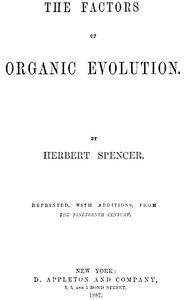
Herbert Spencer opens The Factors of Organic Evolution by directly challenging the sufficiency of natural selection as the sole mechanism of evolutionary change. He argues that the inheritance of functionally-produced modifications—changes resulting from use and disuse of parts—is essential to explain complex phenomena, especially in psychology, ethics, and sociology. The essay, originally published in two parts in The Nineteenth Century in 1886, is here expanded with restored passages. Spencer’s central concern is that Darwin’s habitual use of figurative language, such as “natural selection” and “survival of the fittest,” obscures the concrete physical processes at work. He insists on studying evolution from an exclusively physical point of view, emphasizing that organisms are continuously modified by their environments in ways that are often inconspicuous but cumulatively significant.

Critique of Metaphorical Language

Spencer devotes considerable attention to the pitfalls of metaphorical language in evolutionary theory. He quotes Darwin’s own admission that he “sometimes speak[s] of natural selection as an intelligent power” and personifies Nature for brevity, while acknowledging that Nature means only “the aggregate action and product of many natural laws.” Spencer argues that such figures of speech, though convenient, prevent a full recognition of the fundamental consequences of concrete actions. He extends this critique to his own phrase “survival of the fittest,” noting that “fittest” carries an anthropocentric idea and suggests a fitness analogous to a key fitting a lock—a relation not present in organic adaptation. For Spencer, the word “fittest” must cover cases where an organism may have less individual survival ability but higher fertility, revealing the term’s inadequacy. This linguistic analysis is not mere pedantry; it underpins his call for a shift to a purely physical description of evolutionary processes.

The Physical Point of View

Central to Spencer’s argument is the demand that we study organic changes “from an exclusively physical point of view.” He contends that bodies of all kinds, inorganic and organic, are “from instant to instant subject to the influences in their environments” and are “from instant to instant being changed by these in ways that are mostly inconspicuous.” Over time, these minute changes become conspicuous. This perspective leads Spencer to emphasize that, alongside the special effects that result in differential survival and the inheritance of advantageous traits, many other effects are continuously being wrought on every individual. He insists that a complete account of evolution must consider these pervasive, ongoing modifications—not just the dramatic events of selection. The physical point of view thus broadens the scope of factors to include the cumulative impact of environmental forces on all organisms, not merely those that survive to reproduce.

Inheritance of Functionally-Produced Modifications

Spencer’s core thesis is that the inheritance of functionally-produced modifications is a necessary factor in organic evolution. He argues that without this mechanism, many mental phenomena—especially those of “any considerable complexity”—cannot be explained. In the preface, he outlines the far-reaching implications: if such inheritance occurs, then the mental associations formed by individuals through experiences of actions and their consequences can, over generations, generate innate tendencies. This would provide a basis for the evolution of moral intuitions and higher emotions. Conversely, if only natural selection operates, the genesis of these tendencies remains “not satisfactorily explicable.” Spencer extends this logic to sociology: if a nation is “modified en masse by transmission of the effects produced on the natures of its members by those modes of daily activity,” then institutions and circumstances can mould a population more rapidly than if adaptation relies solely on the selection of random variations. This argument positions Spencer as a proponent of Lamarckian inheritance, a stance that was already controversial in the 1880s.

Structure and Argumentative Strategy

The essay is structured in two parts, originally published separately, and Spencer’s argument unfolds through a combination of theoretical exposition and critical engagement with Darwin. He repeatedly returns to the need for precise language, using Darwin’s own words to highlight ambiguities. The preface reveals that Spencer’s primary motivation is the “profound importance” of the indirect bearings of his argument on psychology, ethics, and sociology. The essay’s movement is from linguistic critique to a call for a physical perspective, then to the case for inherited modifications, and finally to the broader implications. Spencer’s style is methodical and cumulative, building his case through logical steps rather than empirical evidence. He does not present new data but reinterprets known phenomena through his lens. The structure reflects his belief that conceptual clarity is a prerequisite for scientific progress, and his repeated emphasis on “concrete actions, inner and outer” serves as a refrain that ties the sections together.

Spencer’s essay is best approached as a philosophical intervention in evolutionary theory rather than a biological treatise. Readers should attend to his careful dissection of language and his insistence on a physicalist ontology. The argument is tightly woven, with each section building on the previous one. Those interested in the history of evolutionary thought will find here a clear statement of the Lamarckian alternative to Darwinian selection, articulated by one of the nineteenth century’s most systematic thinkers. The essay rewards close reading of its terminological distinctions and its repeated calls to look beyond metaphor to the underlying processes.

I kept thinking about Spencer’s insistence that change isn’t just selection—something quieter, passed along through use. It felt like unfinished business, that idea. Then I came across The Philosophy of Evolution Together With a Preliminary Essay on The Metaphysical Basis of Science — Text and Context, and it seemed to answer that same restless feeling, gently, the way old books sometimes do.

There are no reviews for this eBook.

0
0 out of 5 (0 User reviews )

Add a Review

Your Rating *
There are no comments for this eBook.

Reader reflection

What did you think of this book?

Answer a few questions and save a private reflection on this device.

Your progress 0 / 10
1

What is your current status with this title?

2

What was your overall reaction to the book?

3

Would you encourage someone else to read it?

4

How much effort did this book require?

Related eBooks