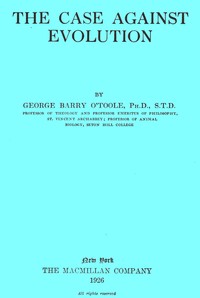
The case against evolution — Story, Setting & Ideas

(0 User reviews)   754
In Category - Evolution
O'Toole, George Barry, 1886-1944 Project Gutenberg 2022 Not confirmed
Evolution Readers of public-domain and historical texts
Project Gutenberg digital edition en

Edition facts

Words 137,384
Reading time 598 min
Text sections 23

For The case against evolution — Story, Setting & Ideas, the stored edition analysis reports 137,384 words, 9 hr 58 min estimated reading time, and 23 detected text sections.

The text analysis averages about 25.4 words per sentence, while the detected sections provide another way to judge how the source is divided.

Project Gutenberg metadata also associates the work with “Evolution,” connecting these edition facts with the source record’s subject description.

A 1925 philosophical and biological critique of evolutionary theory, arguing from a Catholic perspective that the human soul is spiritual and cannot be explained by material evolution. The author, a professor of theology and biology, engages with contemporary scientific evidence, including chromosome studies and fossil reconstructions, to challenge the sufficiency of natural selection and polyploidy.
Share
Editorial Edition Score 4.9/5

Calculated from edition completeness, EPUB availability, text structure and catalogue metadata. Not a user rating.

How this score is calculated
  • Description quality20 pts
  • Title & short description10 pts
  • Source metadata20 pts
  • Text length15 pts
  • Chapters / structure15 pts
  • EPUB file integrity20 pts

Total of 100 points, scaled to a 2.5-5.0 range. Editions with an empty description or a missing EPUB file are not scored.

Edition quality

Public-domain source text

Read the source text

The source text is kept in the dedicated reader, separate from this catalogue record and its commentary.

George Barry O'Toole, a Catholic theologian and biologist, opens The Case Against Evolution by immediately framing his argument in philosophical and scientific terms. The book, published in 1925, targets the materialist assumptions underlying evolutionary theory, particularly the claim that human mental and spiritual faculties can be reduced to biological processes. O'Toole's approach is systematic: he first establishes a distinction between the human soul and the 'bestial soul,' arguing that the latter is 'totally immersed' in matter and incapable of spiritual cognition. This metaphysical foundation sets the stage for a detailed critique of evolutionary mechanisms, including polyploidy and fossil evidence.

The Soul's Distinction

O'Toole devotes significant attention to differentiating the human soul from that of animals. He describes the brute soul as 'an incomplete complement of matter, incapable of existence apart from matter,' and contrasts it with the human soul, which he implies is spiritual. This distinction is not merely theological; O'Toole grounds it in Aristotelian philosophy, citing Aristotle's question: 'whether all attributes of the soul are also shared by that which has the soul or whether any of them are peculiar to the soul itself.' The author argues that brute cognition—sensation, memory, imagination—is 'psycho-organic,' requiring material organs. For example, he notes that 'men born blind can never imagine color,' emphasizing the dependence of animal minds on physical receptors. This section establishes a clear metaphysical boundary that O'Toole will use to challenge evolutionary continuity.

Chromosomes and Polyploidy

In an addendum, O'Toole engages with contemporary genetic research, specifically the work of Theophilus S. Painter on chromosome numbers in mammals. Painter concluded that 'polyploidy cannot be invoked to explain evolution within this class,' noting that the X-Y sex chromosome system complicates such changes. O'Toole seizes on this, arguing that Painter's objection 'excludes evolution by polyploidy from a large portion of the animal kingdom.' This reference shows O'Toole's willingness to use cutting-edge science to bolster his case. He also criticizes reconstructions of Pithecanthropus and Eoanthropus, suggesting that fossil evidence is often overinterpreted. By citing a 1925 Science article, O'Toole positions his work as engaging with the latest empirical findings, not merely philosophical dogma.

The Limits of Sense Perception

O'Toole delves into the mechanics of perception to argue that animal cognition is inherently material. He describes how sensory neurons transmit 'extended neurograms' that form the physical basis of memory and imagination. These neurograms are 'determined both qualitatively and quantitatively by the physical impressions received by the receptors.' For O'Toole, this means that brute thought is always tied to material stimuli; it cannot transcend the physical. He contrasts this with human intellect, which he implies can grasp abstract, immaterial concepts. This argument serves to reinforce his central thesis: that evolution, which posits a gradual development of mental faculties, cannot account for the emergence of a truly spiritual soul. The detailed physiological language—'receptors,' 'axon-fibers,' 'cerebral cortex'—lends a scientific veneer to his philosophical claims.

A First Reading Strategy

When approaching The Case Against Evolution, readers should note that O'Toole's argument unfolds in layers: metaphysical, biological, and epistemological. The opening sections establish his philosophical framework, while later chapters engage with specific scientific evidence. Pay attention to how O'Toole uses contemporary research—such as Painter's chromosome studies—to support his position. Also observe his rhetorical strategy: he often presents a scientific consensus and then points out its limitations or internal contradictions. The excerpts suggest that O'Toole is less interested in denying all evolutionary change than in defending the special status of the human soul. Readers should be prepared for dense prose and technical terminology, but the core argument remains accessible: that materialist evolution cannot explain the immaterial mind.

O'Toole's work is best read as a period piece that reveals the intellectual tensions between science and religion in the early twentieth century. His reliance on Aristotelian philosophy and Catholic doctrine may feel dated, but his engagement with empirical data—from chromosome counts to fossil reconstructions—shows a serious attempt to confront evolutionary theory on its own terms. For modern readers, the book offers insight into a persistent debate about the limits of naturalistic explanation.

I found myself thinking of that 1925 Catholic critique again—how gently its author wrestled with the soul’s untouchable spark amid all those chromosome diagrams. It put me in mind of another old voice, Samuel Butler’s, questioning whether luck or cunning truly drives life’s shaping. Their quiet doubts feel like kindred worries across decades. Luck, or Cunning, as the Main Means of Organic Modification — Reading Companion

There are no reviews for this eBook.

0
0 out of 5 (0 User reviews )

Add a Review

Your Rating *
There are no comments for this eBook.

Reader reflection

Your personal reading reflection

Build a private reading journal entry for this title.

Your progress 0 / 10
1

How far have you progressed with this book?

2

Was reading this book enjoyable?

3

Would you recommend this book to another reader?

4

What was the reading difficulty like?

Related eBooks