Evolution made plain — Reading Companion

(0 User reviews)   1902
In Category - Evolution
Haldeman-Julius, E. (Emanuel), 1888-1951 [Editor], Mason, John (John Harmon), 1867-1968 Project Gutenberg 2025 Not confirmed
Evolution Readers of public-domain and historical texts
Project Gutenberg digital edition en

Edition facts

Words 17,095
Reading time 75 min
Text sections 11

For Evolution made plain — Reading Companion, the stored edition analysis reports 17,095 words, 1 hr 15 min estimated reading time, and 11 detected text sections.

The text analysis averages about 25.3 words per sentence, while the detected sections provide another way to judge how the source is divided.

Project Gutenberg metadata also associates the work with “Evolution,” connecting these edition facts with the source record’s subject description.

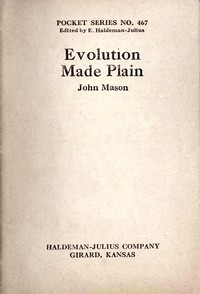
This 1923 primer by John Mason, edited by E. Haldeman-Julius, condenses evolutionary theory into plain language, contrasting natural selection with biblical literalism and tracing the historical intolerance that greeted scientific progress.
Share
Editorial Edition Score 4.6/5

Calculated from edition completeness, EPUB availability, text structure and catalogue metadata. Not a user rating.

How this score is calculated
  • Description quality20 pts
  • Title & short description10 pts
  • Source metadata20 pts
  • Text length15 pts
  • Chapters / structure15 pts
  • EPUB file integrity20 pts

Total of 100 points, scaled to a 2.5-5.0 range. Editions with an empty description or a missing EPUB file are not scored.

Edition quality

Public-domain source text

Read the source text

The source text is kept in the dedicated reader, separate from this catalogue record and its commentary.

John Mason opens Evolution Made Plain with a declaration that scientific truth must enter common life, then immediately narrows his focus: the book will outline fundamental principles of evolution in a few pages, using simple words. The opening chapter, “What Evolution Is and Is Not,” establishes a brisk, declarative voice that defines terms by negation—evolution does not teach that every species improves, nor is it confined to human origins. Mason grounds his explanation in observable natural laws, citing the Jurassic period’s twenty-five reptile orders, of which only five survive, to illustrate extinction and adaptation. This concrete, evidence-first approach sets the tone for a work that aims to demystify rather than celebrate.

A Rhetoric of Refutation

Mason’s prose is shaped by a persistent argumentative stance. He anticipates objections and dismantles them with historical parallels. When addressing the claim that scientists disagree about evolution, he distinguishes disagreement over how natural selection works from consensus that evolution is a fact. This rhetorical move recurs throughout the excerpts: Mason contrasts the “mental slavery” of biblical literalism with the freedom of scientific inquiry. He quotes a 1826 school board letter rejecting railroads as “rank infidelity,” then links that mindset to opposition to evolution. The effect is a cumulative argument that positions evolutionary science as the latest front in a long struggle against intolerance.

Pace and Polemical Digressions

The text’s pace shifts markedly between explanatory passages and polemical asides. Early sections move quickly through definitions and fossil evidence, but later excerpts slow into extended critiques of religious doctrine. Mason devotes several paragraphs to the “noxious growths of superstition” that he claims obscure true Christianity, and he distinguishes between Jesus’ ethical teachings and Paul’s “finely wrought out scheme of redemption.” These digressions, while not central to evolutionary biology, reveal the book’s dual purpose: to educate and to liberate readers from what Mason sees as intellectual bondage. The change in pace—from brisk science to heated polemic—reflects the author’s conviction that understanding evolution requires clearing away ideological obstacles.

Voice and the Plain-Style Ideal

Mason cultivates a plain, accessible voice consistent with the Pocket Series format. He addresses the reader directly, uses short sentences, and avoids technical jargon. The epigraphs from Agassiz, Bacon, Lincoln, and an anonymous source reinforce this democratic ethos. Yet the voice is not neutral: it carries a moral urgency. Phrases like “the very negation of the Christ spirit” and “dregs of which lie at the bottom of every human soul” inject emotional weight. This combination of simplicity and fervor suggests that Mason sees his task as both instructional and reformist. The plain style is a deliberate strategy to make scientific reasoning feel immediate and consequential.

Evolution Made Plain rewards readers who attend to its rhetorical structure as much as its scientific content. Mason’s shifts in pace—from concise definition to historical anecdote to theological critique—map the intellectual terrain he believes must be crossed before evolution can be accepted. The book is best read as a period artifact of popular science writing, where persuasion and explanation are intertwined. Its value lies not in advancing new theory but in demonstrating how evolutionary ideas were translated for a general audience in the early twentieth century.

Flipping through the 1923 primer, I was struck by how gently it led the reader toward difficult truths, much like an old friend. That patient unfolding put me in mind of a quieter essay, The Rise and Progress of Palaeontology Essay #2 from "Science and Hebrew Tradition" — Context and Discussion, where fossils speak not to shock, but to reassure us of time's vast, unhurried story. Their shared tone feels like a whispered secret from another era.

There are no reviews for this eBook.

0
0 out of 5 (0 User reviews )

Add a Review

Your Rating *
There are no comments for this eBook.

Reader reflection

How will you remember this book?

Save your reaction, strongest insight, and memorable passage.

Your progress 0 / 10
1

Which reading stage best describes you?

2

Was reading this book enjoyable?

3

Would you encourage someone else to read it?

4

How demanding did the text feel?

Related eBooks