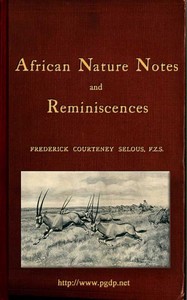
African Nature Notes and Reminiscences — Edition Insights
Edition facts
The source record for African Nature Notes and Reminiscences — Edition Insights measures this digital text at 126,881 words, 9 hr 12 min estimated reading time, and 14 detected text sections.
The text analysis averages about 36.8 words per sentence, while the detected sections provide another way to judge how the source is divided.
Project Gutenberg metadata also associates the work with “Natural history -- South Africa,” connecting these edition facts with the source record’s subject description.
Calculated from edition completeness, EPUB availability, text structure and catalogue metadata. Not a user rating.
How this score is calculated
- Description quality20 pts
- Title & short description10 pts
- Source metadata20 pts
- Text length15 pts
- Chapters / structure15 pts
- EPUB file integrity20 pts
Total of 100 points, scaled to a 2.5-5.0 range. Editions with an empty description or a missing EPUB file are not scored.
Public-domain source text
Read the source text
The source text is kept in the dedicated reader, separate from this catalogue record and its commentary.
Frederick Courteney Selous opens this collection with a telling detail: his manuscript notes on lions had lain in a drawer for years until President Theodore Roosevelt’s encouragement prompted their publication. The book is neither a continuous narrative nor a systematic natural history, but a gathering of articles written over a decade, some previously printed in The Field and Land and Water. Selous explicitly abandoned an earlier plan for a comprehensive work on South African mammals when he contributed to Rowland Ward’s Great and Small Game of Africa. What remains is a series of discrete, evidence-rich observations, shaped by the author’s dual identity as a hunter and a naturalist awarded the Royal Geographical Society’s Gold Medal.
Tsetse Flies and Domestic Animals
Selous offers a precise, comparative account of how different species and breeds respond to tsetse fly exposure. He notes that his five donkeys, after a month in fly country, developed swelling at the navel and eye discharge but survived, later recovering fully. In contrast, horses weakened rapidly: one broke its back in a game pit, and others became too weak to carry a man after a fortnight. At Zumbo, Portuguese settlers kept pigs that foraged daily in fly-infested areas yet remained healthy, though they were “miserably thin.” Selous distinguishes between indigenous goats, which resist the fly, and European-derived Cape and Angora goats, which do not. He also observes that native dogs tolerate the flies, while European breeds succumb. These observations are grounded in repeated, firsthand encounters rather than secondhand reports.
The Hunter’s Craft and the Naturalist’s Eye
Selous’s prose blends practical hunting knowledge with natural history. When his horses were attacked by tsetse flies along the Revue River, he recognized the insects by their “peculiar buzz” and dismounted immediately. He and a companion caught sixteen flies by pinning their feet with a knife blade, then had Kafirs use branches to keep the flies off until the horses were led beyond the fly belt. The horses, in good condition, were unaffected despite two or three flies feeding fully. Selous also notes seasonal activity: tsetse flies are most active in hot weather, and during winter months they appear only after the sun is high. Such details reveal a methodical observer who records not only what happens but under what conditions.
Structure and Scope: A Fragmentary Record
The book’s composition is as instructive as its content. Selous states that the chapters were written at various times over ten years, with the lion material intended as the start of a larger project. The dedication to Theodore Roosevelt—who also contributed a foreword—frames the work as a response to presidential encouragement rather than a systematic treatise. The preface acknowledges that most of the chapters remained in manuscript until 1905. This origin explains the book’s episodic character: each section stands as a self-contained observation, often focused on a single species or phenomenon. Readers should expect detailed, localized accounts rather than a unified argument or comprehensive survey of African natural history.
Selous’s authority rests on decades of travel and hunting across southern Africa, from the Chobi River to the Zambesi. His notes resist easy generalization; they demand that readers attend to specific conditions—season, breed, location—that shape animal behavior and survival. The book rewards those who read it as a field journal rather than a textbook, valuing the concrete detail over the sweeping claim.
There’s something about Selous watching those oxen shrug off the tsetse—life finding its quiet workarounds—that lingered with me long after I put the book down. It feels like a small echo of that older, stranger effort to trace how living things hold themselves together. Hints towards the formation of a more comprehensive theory of life. — Background and Themes hums beside it, gently unfinished, like a memory of a thought.
There are no reviews for this eBook.
How did this book work for you?
Your answers remain private and are stored only in this browser.