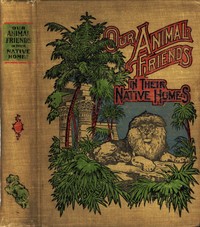
A Natural History for Young People: Our Animal Friends in Their Native Homes including mammals, birds and fishes — Background and Themes
Edition facts
For A Natural History for Young People: Our Animal Friends in Their Native Homes including mammals, birds and fishes — Background and Themes, the stored edition analysis reports 94,537 words, 6 hr 52 min estimated reading time, and 88 detected text sections.
The text analysis averages about 23.6 words per sentence, while the detected sections provide another way to judge how the source is divided.
Project Gutenberg metadata also associates the work with “Natural history -- Juvenile literature,” connecting these edition facts with the source record’s subject description.
Calculated from edition completeness, EPUB availability, text structure and catalogue metadata. Not a user rating.
How this score is calculated
- Description quality20 pts
- Title & short description10 pts
- Source metadata20 pts
- Text length15 pts
- Chapters / structure15 pts
- EPUB file integrity20 pts
Total of 100 points, scaled to a 2.5-5.0 range. Editions with an empty description or a missing EPUB file are not scored.
Public-domain source text
Read the source text
The source text is kept in the dedicated reader, separate from this catalogue record and its commentary.
Phebe Westcott Humphreys opens her preface with a personal motivation: as a child, she found no natural history that was both scientifically classified and written in words of easy reading. This tension between rigorous taxonomy and youthful readability shapes every page of A Natural History for Young People: Our Animal Friends in Their Native Homes. The work does not simply describe animals; it arranges them into families, explains necessary scientific terms, and draws on authorities from Goldsmith to Brehm. Yet the excerpts reveal a persistent contrast between the domestic and the wild, the tame and the untractable, that may reflect the author's own negotiation between scholarly system and child-friendly narrative.
Classification as a Promise and a Problem
Humphreys announces that her volume will carefully classify mammals, birds, and fishes into proper families, discarding unnecessary scientific words. The excerpts show this in practice: the ruminants are divided into those with hollow horns and those that shed their horns, with precise descriptions of antler growth—brow-antler, tines, burrs. Yet the classification is not purely Linnaean. The author also groups animals by utility and temperament. The yak is described as restless and wilful, the common buffalo as wild and untractable, while the jungle ox is simply said to resemble the common ox. This mixing of morphological and behavioral categories suggests that the young reader is expected to learn both scientific order and moral or practical lessons about animal character.
Domestic Utility Versus Wild Nature
A striking pattern in the excerpts is the repeated juxtaposition of an animal's wild state and its domestic usefulness. The yak, found undomesticated on the confines of Chinese Tartary, becomes a useful servant when broken in, providing milk, strength, flesh, and hair. The common buffalo, delighting in wallowing in marshy plains, is valuable for ploughing rice fields but must be controlled with a ring through its nostrils. Even the American deer, though not described in the domestic context, is introduced through the technical details of antler shedding—a natural process that also implies a cycle of growth and loss. Humphreys seems to present animals as creatures that can be known both in their native homes and through their roles in human economies, a dual perspective that may have appealed to children curious about the wider world.
The Authorial Voice Between Scholar and Mother
The preface reveals a layered authorial identity. Humphreys writes as a former child who longed for an accessible natural history, as a scholar who consulted French, German, Greek, and Latin dictionaries, and as a mother addressing the demands of her small son—an animated interrogation point. This triple voice inflects the text: the scientific explanations are careful, but the framing is personal. The author does not claim to have written a complete treatise; she acknowledges the immensity of the labor and the delay caused by other books. The result is a work that presents itself as both authoritative and intimate, a response to a felt lack rather than a comprehensive survey. Readers should note that the excerpts do not reveal how consistently this voice is maintained across the full 88 sections.
Readers approaching this 1900 volume should attend to the interplay between its systematic structure and its anecdotal details. Humphreys often moves from general family traits to specific observations about temperament or human use, creating a rhythm that may help young readers remember facts. The book is best read not as a field guide but as a historical document of how natural history was once presented to children—with a foot in both the scientific and the domestic worlds.
There’s something tender about a 1900 book patiently explaining which animals belong by the hearth and which belong to the wild, as if childhood itself were a kind of habitat to be mapped. I found myself thinking of that gentle curiosity while glancing at Significant Achievements in Space Bioscience 1958-1964 — Edition Insights — a different century, yet the same hush before wonder, the same hopeful naming of things.
There are no reviews for this eBook.
How will you remember this book?
Save your reaction, strongest insight, and memorable passage.