
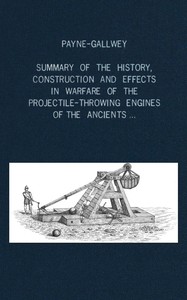
A summary of the history, construction and effects in warfare of the…
Okay, let's clear something up first. This isn't a novel with a plot. Think of it more like the most fascinating owner's manual for medieval siege weapons you'll ever read. Sir Ralph Payne-Gallwey, writing over a century ago, was obsessed with figuring out how these machines actually worked. He wasn't content with old drawings; he wanted the specs, the physics, and the hands-on experience.
The Story
The 'story' here is the life cycle of these weapons. Payne-Gallwey walks you through everything. He starts with the history, showing how the crossbow evolved from a hunting tool into a weapon that could punch through armor and change battlefields. Then, he gets into the nitty-gritty: the different types of wood for the stock, the making of the steel bow, the intricate trigger mechanism. He does the same for the big guys—the mangonels, ballistae, and trebuchets. He explains the math of counterweights, the best materials for slings, and how a crew of 50 men would operate one in the field. The 'conflict' is the constant arms race between building stronger castle walls and building bigger, more powerful machines to smash them down.
Why You Should Read It
What makes this book special is the author's passion. You can feel his excitement when he describes reconstructing a giant crossbow and firing it on his estate. He turns engineering into a detective story. Reading it, you stop seeing a trebuchet as just a CGI effect in a movie. You understand it as a complex piece of pre-industrial machinery that required skilled carpenters, blacksmiths, and soldiers to work. It makes you appreciate the sheer ingenuity and brute-force problem-solving of the medieval world. It’s a powerful reminder that history isn't just about kings and dates; it's about the tools people built and how they used them.
Final Verdict
This is a perfect pick for anyone who loves detailed, hands-on history. If you're a fan of shows like 'Forged in Fire' or YouTube channels that explore old technology, you'll feel right at home. It's also great for fantasy writers or tabletop gamers who want authentic details for their worlds. A word of caution: it is a dense, old book with technical diagrams. It's not a breezy read, but if you have even a passing curiosity about how things worked in the past, it is absolutely captivating. You won't look at a castle wall the same way again.
Elizabeth Wright
1 year agoAmazing book.
Sandra Nguyen
5 months agoRecommended.
Mary Ramirez
1 year agoIf you enjoy this genre, the plot twists are genuinely surprising. I would gladly recommend this title.
Deborah Brown
2 months agoIf you enjoy this genre, it manages to explain difficult concepts in plain English. This story will stay with me.





Charles Robinson
1 year agoGreat read!