
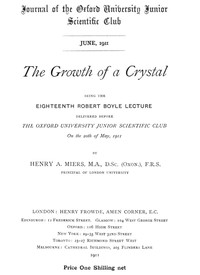
The Growth of a Crystal by Henry Alex Miers
Let's clear something up first: this isn't a novel. Published in 1902, The Growth of a Crystal is Henry Alex Miers's detailed explanation of how crystals form, grow, and develop their signature shapes. Think of it less as a story with characters, and more as a guided tour of a silent, miniature construction site.
The Story
There's no protagonist in the traditional sense. The 'star' here is the crystal itself. Miers starts with the basics—what even is a crystal?—and then walks you through the entire life cycle. He explains how dissolved substances in a solution come together, particle by particle, following strict geometric rules. He shows how the initial 'seed' of a crystal determines its final, often stunningly complex, shape. The 'plot' is the journey from disorder to perfect order, from invisible molecules to a tangible, glittering solid. Miers acts as your narrator, pointing out the 'why' behind every angle and facet.
Why You Should Read It
I picked this up on a whim, expecting a dry reference book. What I found was a work of genuine passion. Miers writes with a clarity that feels like a conversation. You can tell he's fascinated, and that excitement is contagious. The real magic isn't in memorizing scientific terms; it's in the shift in perspective. After reading it, I spent an afternoon just looking at sugar cubes and snowflakes differently. The book gives you a secret decoder ring for the physical world. It argues that beauty in nature isn't random—it's the direct result of simple, elegant rules playing out millions of times.
Final Verdict
This is a niche read, but a wonderful one. It's perfect for curious minds, amateur scientists, artists, or anyone who likes to understand how things work. If you enjoyed Mark Kurlansky's 'Salt' or Carlo Rovelli's physics books for their ability to make science feel immediate and wondrous, you'll appreciate Miers's century-old charm. It's not a fast-paced thriller; it's a slow, thoughtful walk with a brilliant guide. Keep an open mind, and you might just discover a new way of seeing the world right under your nose.
Matthew Brown
1 year agoHaving read this twice, it challenges the reader's perspective in an intellectual way. Worth every second.
Jennifer Allen
1 year agoAfter finishing this book, the arguments are well-supported by credible references. I will read more from this author.
Ashley Ramirez
11 months agoFrom the very first page, the flow of the text seems very fluid. I would gladly recommend this title.
Emily White
6 months agoVery helpful, thanks.