
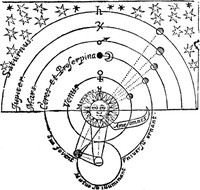
The discovery of a world in the moone : or, A discovrse tending to prove that…
Forget everything you know about the moon landing, telescopes, and modern science. Step into 1638, a time when most people saw the moon as a perfect, smooth celestial light. Then along comes John Wilkins, a 24-year-old thinker, with a book that dared to suggest the moon was another Earth.
The Story
There's no traditional plot with characters. Instead, the 'story' is the argument itself. Wilkins builds his case point by point, like a lawyer proving a shocking theory. He starts by embracing the controversial work of Galileo, who saw mountains and valleys on the moon through his telescope. Wilkins says: if it has landscapes, it must be a solid body. If it's a solid body, why couldn't it be a world? He then tackles the big objections. How could people live there? Maybe they don't need air like we do, he speculates. How do we get there? He seriously discusses the possibility of a flying chariot or a ship with mechanical wings. The book is a journey of logical steps, each one pushing the boundaries of what was considered possible, all aimed at proving that our 'lesser light' in the night sky is a neighbor waiting to be visited.
Why You Should Read It
This book is a blast because it captures a specific, thrilling moment in history—the moment imagination caught up with observation. You're not reading dry facts; you're reading the excitement of a new idea. Wilkins isn't just presenting a theory; he's wrestling with it, problem-solving the holes in real-time. His guesses are often wrong (spectacularly so), but his method of asking 'why not?' is inspiring. It’s humbling and exhilarating to see the birth of a concept—space travel, alien life—from its very first, clumsy breaths. You get to witness the raw, untamed curiosity that eventually led to science fiction and real science.
Final Verdict
Perfect for anyone who loves history, astronomy, or just a great 'what if' story. If you enjoy shows like 'Cosmos' that connect scientific discovery to human wonder, you'll love this. It's a short, accessible read (the old English style is easier than you think!) that packs a huge punch. It’s not a textbook about the moon; it’s a time capsule of the moment we first dreamed of going there.
John Moore
5 months agoI had low expectations initially, however the content flows smoothly from one chapter to the next. Exactly what I needed.
Brian Gonzalez
1 year agoEnjoyed every page.


Joshua White
2 months agoVery interesting perspective.